Mike’s Top Ten of 2023
2023 is a fascinating year. On the one hand, interesting theatrical movies for people who want more than the usual ‘franchise and remake’ fare returned in a big way. The Barbenheimer phenomenon was truly something to behold and actually brought people back to theaters in a legitimate manner for the first time in three years. The part that went understated about those two is how both were (ostensibly) original and unique films. Sure, one is based on a doll, but everything about that movie is more unique than almost anything else that came out the rest of the year. And I love that, especially because the past few years were rough for theatrical films in wide release that appealed to people who wanted something more than just mindless entertainment.
On the other hand, I look at 2023 and think, “What a terrible year for movies.” Part of that is because of the strike that happened. So many films got pushed out of the year, either because they couldn’t get finished or couldn’t be promoted (plus there’s always a handful of films that shoot throughout the year that come out at the end, and those didn’t happen like they usually do). And so what we were left with — at least from my perspective — was a year that was so thin I almost couldn’t fill out a Top Ten list. Every year, I can get to 80 movies easily. This year, I struggled. I barely got to my quota (and that was after watching the stuff that would normally be icing on the cake for me — the shortlisted foreign films and documentaries). Even getting past 10 was tough. Figuring out 11-20 was the hardest I’ve ever had for a current year ever. It was rough.
And I understand it, but it’s weird to have that dichotomy. There doesn’t feel like there’s a middle class this year. I’m so curious how 2023 will age for me. Though I guess I feel the same way about 2020, 2021 and 2022 as well. So I guess we’ll see.
Mike’s Top Ten of 2023
Asteroid City
Barbie
The Holdovers
The Killer
Killers of the Flower Moon
Mission: Impossible – Dead Reckoning Part One
Oppenheimer
Past Lives
Poor Things
The Zone of Interest
11-20: Air, American Fiction, Are You There God? It’s Me Margaret., Beau Is Afraid, The Boy and the Heron, The Boys in the Boat, If You Were the Last, Indiana Jones and the Dial of Destiny, No One Will Save You, Pinball: The Man Who Saved the Game
Tier Two: Anatomy of a Fall, The Caine Mutiny Court-Martial, The Creator, Dicks: The Musical, Dream Scenario, Dreamin’ Wild, Dungeons & Dragons: Honor Among Thieves, Elemental, How to Blow Up a Pipeline, The Iron Claw, John Wick: Chapter 4, Maestro, Master Gardener, Napoleon, No Hard Feelings, Priscilla, Saltburn, Sanctuary, Spider-Man: Across the Spider-Verse, Teenage Mutant Ninja Turtles: Mutant Mayhem
Tier Three: All Dirt Roads Taste of Salt, Anyone But You, The Blackening, Boston Strangler, Bottoms, The Burial, The Color Purple, The Covenant, Dumb Money, Ferrari, Flora and Son, The Hunger Games: The Ballad of Songbirds and Snakes, Joy Ride, May December, The Old Oak, The Peasants, Society of the Snow, Suzume, Theater Camp, They Cloned Tyrone
Tier Four: BlackBerry, Butcher’s Crossing, Cat Person, Creed III, Foe, Guardians of the Galaxy Vol. 3, How to Have Sex, Medusa Deluxe, Next Goal Wins, Nimona, Nyad, Operation Fortune: Ruse de Guerre, Polite Society, Quiz Lady, The Royal Hotel, Tetris, They Shot the Piano Player, Totally Killer, Waitress: The Musical
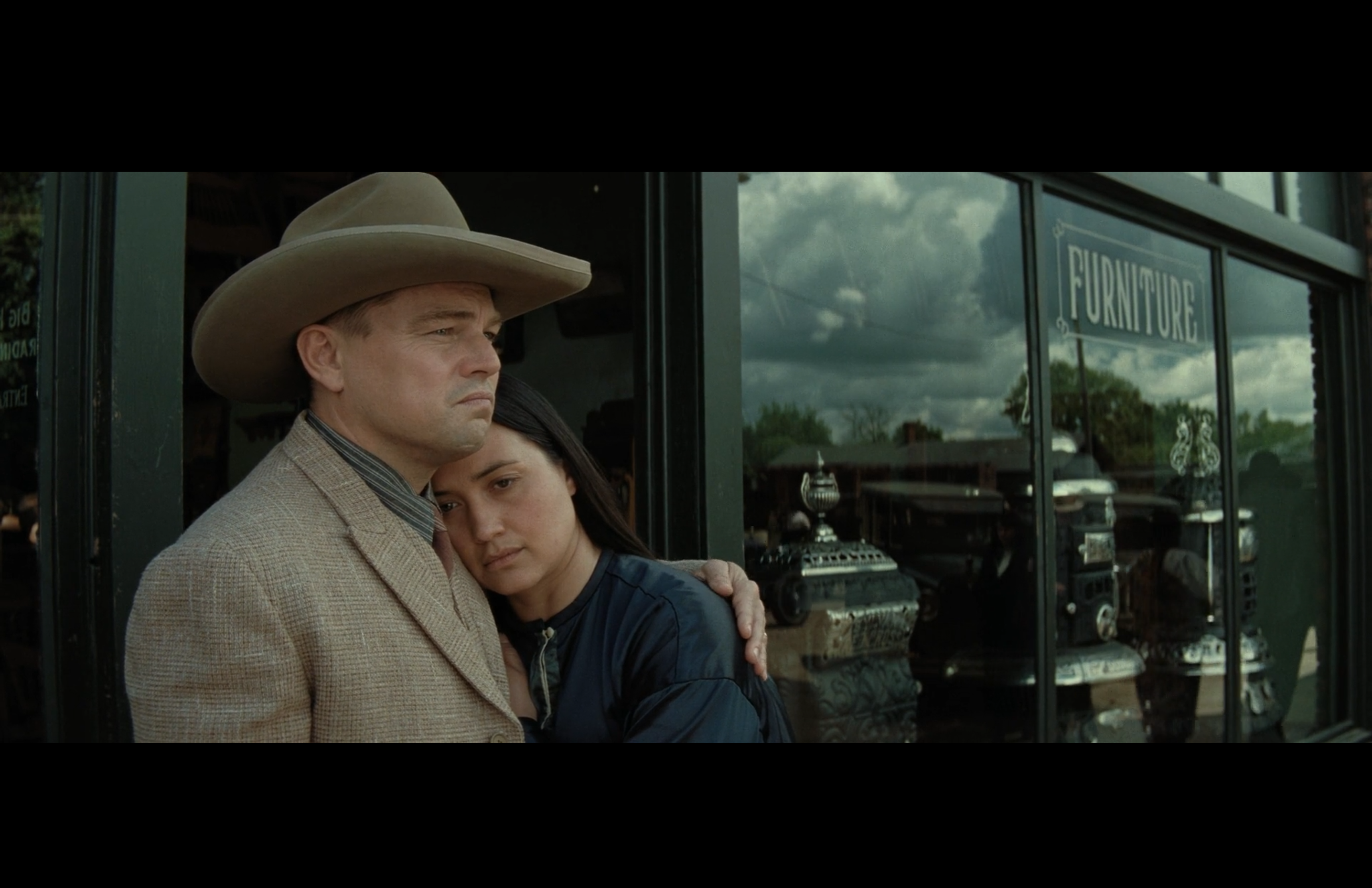
1. Killers of the Flower Moon
“Can you find the wolves in this picture?”
It’s crazy to me that Scorsese has been a fixture on these lists for 50 years. Truly. Mean Streets is 1973. This is his eighteenth film in the Top Ten. The fact that he’s still making masterpieces is wild.
When The Irishman came out, I referred to it as Scorsese’s Cheyenne Autumn. That was because Cheyenne Autumn was John Ford’s final film within the genre he was best known for, acting as both an elegy for the genre and his career within it. But Cheyenne Autumn is, in actuality, a western about the injustice of Native Americans by the hands of the government. So this is also kinda Scorsese’s Cheyenne Autumn.
What I find most fascinating about this film is the idea that, had it not been made at this time, at this stage in Scorsese’s career and life, we wouldn’t have gotten this exact film. There are so many alternate versions of this story that could’ve been (most notably with DiCaprio in the Plemons role and the main plot being about the investigation into the murders), many of which probably wouldn’t have had the thought and care put into showing the perspective of the Osage, having everything taken from them (especially the acknowledgement at the end that, quite literally, even this story was taken away from them). And I think the way things worked out, this version is probably the most complete version Scorsese could’ve made.
Everything about this film is incredible. Starting with the performances. The way DiCaprio plays tender and stupid, but also naively evil, is some of the best acting he’s ever done (and it’s a shame people seem to be overlooking that). De Niro gives his most nuanced piece of work in 25 years. The way he plays the Devil in sheep’s clothing really does hold up among his earlier work in Scorsese’s films (which, for those counting, includes Taxi Drive and Raging Bull). And Lily Gladstone, what more is there to say about her? She’s so towering in her performance that you wish the plot didn’t have to sideline her for much of the second half of the film. Plus you have Robbie Robertson’s perfect score, Rodrigo Prieto’s stunning cinematography to the legend Jack Fisk’s incredible production design, Jacqueline West’s understated but sumptuous costumes, and the maestro Thelma Schoonmaker’s editing, which continues to awe fifty years in.
It’s crazy to me that Scorsese keeps making masterpieces this far in, and how endless his curiosity is in wanting to tell these stories and find new ways to tell them. This film deals with themes he’s been dealing with his entire career and yet still finds a way to tell them that feels fresh and fitting for where he’s at as a filmmaker and where the world is at the time he’s telling this story. Plus, I find that when he makes a film like this, set in a time period he’s not wholly familiar with, he likes to get into historical detail, show you how the people lived and expand his films with all sorts of details that might not necessarily serve the story in the moment but also stick out to you as authentic (because you can tell he’s interested in them).
There’s a sense of culmination with this film (underscored by it being the first time De Niro and DiCaprio are in a Scorsese film together). While The Irishman put Scorsese’s work in a specific genre to rest, this feels almost like it’s the capstone to Scorsese’s entire career (which isn’t to say it’ll be his last film. I certainly hope he’s got a few more in him). It feels like the great final chapter, leading to a hopefully extended epilogue where we can see the master continue his work for as long as he can.
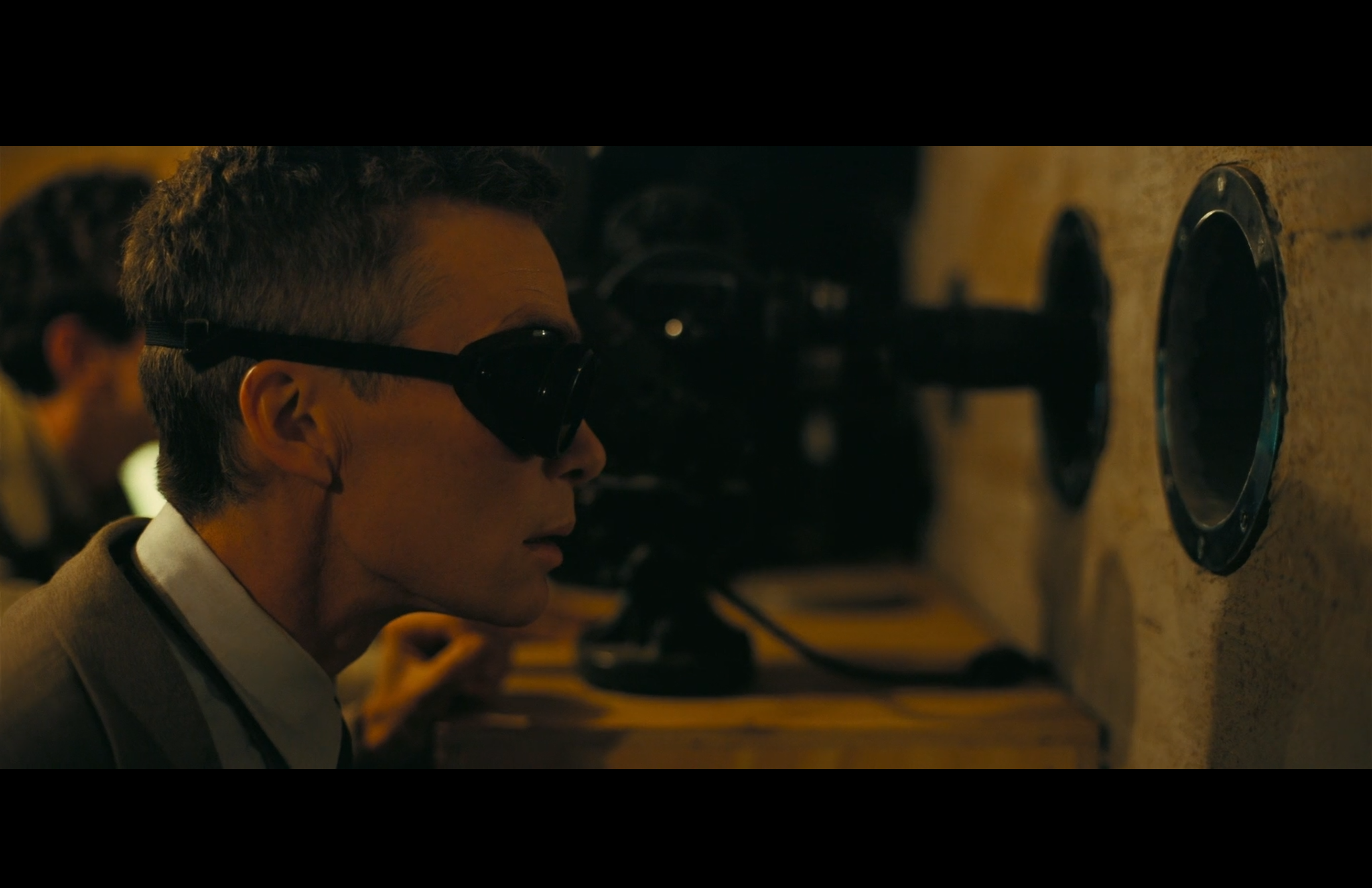
2. Oppenheimer
“When I came to you with those calculations, we thought we might start a chain reaction that would destroy the entire world.”
“I remember it well. What of it?”
“I believe we did.”
A film like this gives me hope. Because Christopher Nolan, as we know, is the master of summer tentpole filmmaking nowadays (as a single entity. I’m not counting the studios and franchises that lay claim to the summer now with their assembly lines). When he makes a film, it’s an event. And the people who are conditioned to see his movies expect things like Inception or Dark Knight. And yet, lately, we’ve gotten things like Dunkirk and this. This is the most straightforward drama he’s made in 20 years (if not ever). And because he is who he is, he got millions of people to sit in a theater for three-hours to watch something that’s essentially people talking. About history! And science! And that’s wild to me. I love that he could turn a biopic into an event film.
This also isn’t your standard issue biopic. Imagine this story being made in any other era before now. There is no chance it wouldn’t be at least 85% ‘rah rah’ history. But this film — this is messy, and complicated, and shows a lot of different sides at once. Hell, the bomb goes off two hours into the film and we still have another whole hour dealing with literal and figurative fallout, where the country turns on this guy and rips him to shreds for it, all while he’s dealing with having to live with what he’s done. It’s great stuff.
Cillian Murphy is incredible, and it’s wonderful to see him getting that perfect leading role that’s eluded him for so many years. The cast is loaded with wonderful actors and great performances (David Krumholtz, Josh Hartnett and Jason Clarke in particular really stand out). The film looks incredible. Hoyte van Hoytema shoots the hell out of it. Ludwig Göransson’s score is out of this world. Jennifer Lame’s editing is on point. The makeup jobs here are crazy good. Tom Conti as Einstein? My word. Also, more attention needs to be paid to the fact that Nolan brought Robert Downey Jr. into proper acting again, after 15 years in Marvel land. Dude got Downey to show everyone just how good he is again (and hopefully brings him back to doing more stuff like this, because I remember how good that run was leading up to the first Iron Man).
I love that so many things happen at once in this movie. How we get the messy side of Oppenheimer’s personal life, to the driving ‘let’s beat the Russians to this bomb’ story that most people would expect (even though that’s fraught with all sorts of politics and infighting, which is awesome), to the personal grudge of Lewis Strauss, to the fact that this country actively tore this man down after he accomplished one of the most remarkable feats of the 20th century, to the personal guilt he himself had to live with, knowing what he was going to be doing as he did it. It’s a beautiful mix of a lot of different things in a film that could have been very straightforward and barely scratched the surface of half of them.
I want to point out one thing that interests me, as I write this without knowing where things are headed: this film marks 25 years for Nolan, since his first film, Following. In that time, he’s established himself as one of the leading filmmakers in Hollywood, someone who cares about film and the filmmaking process (and also fights for things like keeping film stock alive). And before this film, he’d clearly been embraced by audiences, but before now the awards groups and all of that side of things really shunned him and dismissed all he did (the technical side, sure, but him? Very much dismissed). It’s kind of like how Spielberg was shunned for many years until finally he made something they couldn’t ignore. So I’m interested — now that Nolan has achieved that perfect moment, where he’s gotten the financial acclaim, critical acclaim and won all the awards… what does he do next? What frontier is there for him to go to? I’m fascinated to see what he chooses to do now.

3. Barbie
“You’re so beautiful.”
“I know it.”
How did this film get made? That’s what I keep asking myself. Because they were gonna make this for years — there was a version of this that starred Amy Schumer. And I guarantee you it wouldn’t have been anything near what this is. But I think the answer to all the questions and amazement I have about this film can be summed up with: Greta Gerwig.
This film is entirely her and her creation. Anyone that had any doubt this movie would be great need only have looked at her previous two films, Lady Bird and Little Woman, to know that she was going to deliver the goods. Her making this felt sort of like when I found out Denis Villeneuve was making Blade Runner (or Dune); I said, “Sure, you can, but I feel like this is depriving us of your talents with more original concepts.” And, like with Denis Villeneuve and those films, the result is so much better than I ever could’ve imagined.
I don’t even know where to begin talking about this film because there’s so much I can talk about. The writing, the tone, the performances (Margot Robbie is so good I think people took for granted how good she is in this. Ryan Gosling we all understand how good he is here. And America Ferrera — absolutely terrific work), the fact that it works in a full-on Busby Berkeley musical number, the brilliant recreation of all the production design and costumes, the absolute emotion the film manages to elicit alongside all the silliness of a lot of the plot, the songs (there’s like five great original songs in this movie), that beautiful scene on the bench with Ann Roth — truly there are dozens of things you can talk about with this film.
But there’s one thing I want to talk about in specific, and it’s the message. It’s messaging you saw in Lady Bird and in Little Women, but this is different. This is the largest platform Greta Gerwig has had (the entire worldwide box office grosses for Lady Bird and Little Women combined are less than what this film made in its first week). She could have told a very ‘safe’ version of this story. But instead she tells a version of this story that not only recontextualizes the Barbie doll for generations to come, but also uses that to tell women and young girls that they can be and do anything, and that the world is a worse place when men tell the women what to do and who to be. And yes, the messaging and the way it’s portrayed in this film is not exactly complicated and it’s not some great milestone in feminism. That’s not the point. This movie is primarily for young girls. There is a whole generation (and hopefully more, moving forward) of young girls who are watching this movie at age five, six, seven. And maybe they don’t understand all the jokes or everything that’s going on. But the themes of this movie are going to sink in, and the things this movie has to say are going to be a part of them as they grow up. And that is something you cannot put a price on and is something that, on top of all the other amazing and wonderful things this movie does, makes it truly one of the best films of the year.
Also — I will forever be in awe at the fact that Greta Gerwig managed to get away with the final line of this film. The fact that she got Universal and Mattel and all the companies involved in this to allow that line to happen is absolutely legend shit.

4. The Holdovers
“He was a great kid. I had him one semester. Very insightful.”
“Mm-hmm. He hated you. He said you were a real asshole.”
“Well, uh, like I said… sharp kid, insightful.”
You know Alexander Payne set out to make a movie that looks like something from 1970 you’d stumble upon on TCM and go, “I didn’t know this existed.” That’s the feeling of this one. Or like, when you discover an old paperback and the back just reads as something that you know you’re gonna like and you can’t wait to crack it open.
I’m also certain he wanted to make a movie in the style of Hal Ashby, because that’s exactly what this movie is. And he, as a filmmaker, is the closest thing to Hal Ashby we have nowadays. His films are also sort of loose, narratively, and are more about hanging out with the characters and showing you more about them the more we spend time with them. They’re also hugely emotional without seemingly trying to be. Few people can pull that off like he can. If it weren’t for the fact that he’s already made About Schmidt and The Descendants (and Nebraska and Sideways), I’d say this is his best film. It still may be his best film.
I knew from the opening moments of this that I was going to get something I loved dearly. And that was only compounded the minute I met Paul Giamatti’s character. And then Dominic Sessa’s character. And then Da’Vine Joy Randolph’s character. There’s such richness here. Every character is a human being I want to know more about, and then want to spend more time with. Every frame of the film is beautiful to look at. The atmosphere of the film is perfect and sets you firmly within its time period and location. The cinematography is stunning (how Eigil Bryld didn’t manage a nomination for it is beyond me). The writing is top notch (this is the second Payne script, after Nebraska, that he doesn’t have a writing credit on that fully feels like something he’d have written). And, most importantly, this is a film you can put on at any time and just enjoy the hell out of. The fact that he has multiple films like this is a testament to him as a filmmaker.
There’s something to be said about a movie you can see once and feel like you’ve already had it around your entire life. Something that you find yourself liking more and more each time you revisit it. This is that old paperback for me, that I will keep pulling off the shelf time and time again. It’s perfect.

5. The Killer
“My process is purely logistical, narrowly focused by design. I’m not here to take sides. It’s not my place to formulate any opinion. No one who can afford me, needs to waste time winning me to some cause. I serve no god, or country. I fly no flag. If I’m effective, it’s because of one, simple fact: I. Don’t. Give. A. Fuck.”
It’s amazing to me how David Fincher takes projects that, in the hands of just about any other director, would be generic, straight-to-streaming, forgettable crap, and turns them into some of the best movies of their respective years. This is like the third or fourth time he’s done that. It’s wild.
Like a lot of Fincher films, I think what people tend to overlook about it is how damn funny it is. The whole movie is absolutely absurd, and yet it’s being played as straight as Leslie Nielson in Airplane or The Naked Gun. But that’s the beauty of the film. It’s so stylistic and sleek that it almost doesn’t matter how much of a fuck up this guy is or how insane the whole story is. But that’s the genius of Fincher as a filmmaker. He deconstructs the hitman genre in such a way that you don’t even need to notice he’s doing it if you want.
The opening sequence is masterful, designed as this badass sequence of a professional talking about how to pull off the perfect hit. It lasts like fifteen minutes and of course, at the end, he actually misses his shot. Which leads to a great low speed escape (not exactly a Bourne-style car chase through Europe) and him having to lay low (with passports that have the names of television characters), avoid the people who were sent to kill him because he fucked up (getting his girlfriend brutally assaulted because of it and leading to a series of extra, wholly unnecessary murders) and eventually take revenge on those people (which also goes very wrong, from a staple gun killing its intended target much sooner than expected to the whole scene with the dog). My favorite is near the end when he manages to gain entry to his target’s home through a free trial membership and things bought on Amazon. The whole movie is patently absurd and wonderful at the same time.
But also, in between all that are some great sequences. The entire interlude with Tilda Swinton is absolutely wonderful. All the other sequences, while with an undercurrent of dark humor, are incredibly well put-together. The fight inside the house is one of the best choreographed fights in recent years. Fassbender is tremendous in the role (it’s almost like if M. Hulot was playing Le Samourai), and Fincher once again manages to elevate source material that would not have been elevated by anyone else making it.
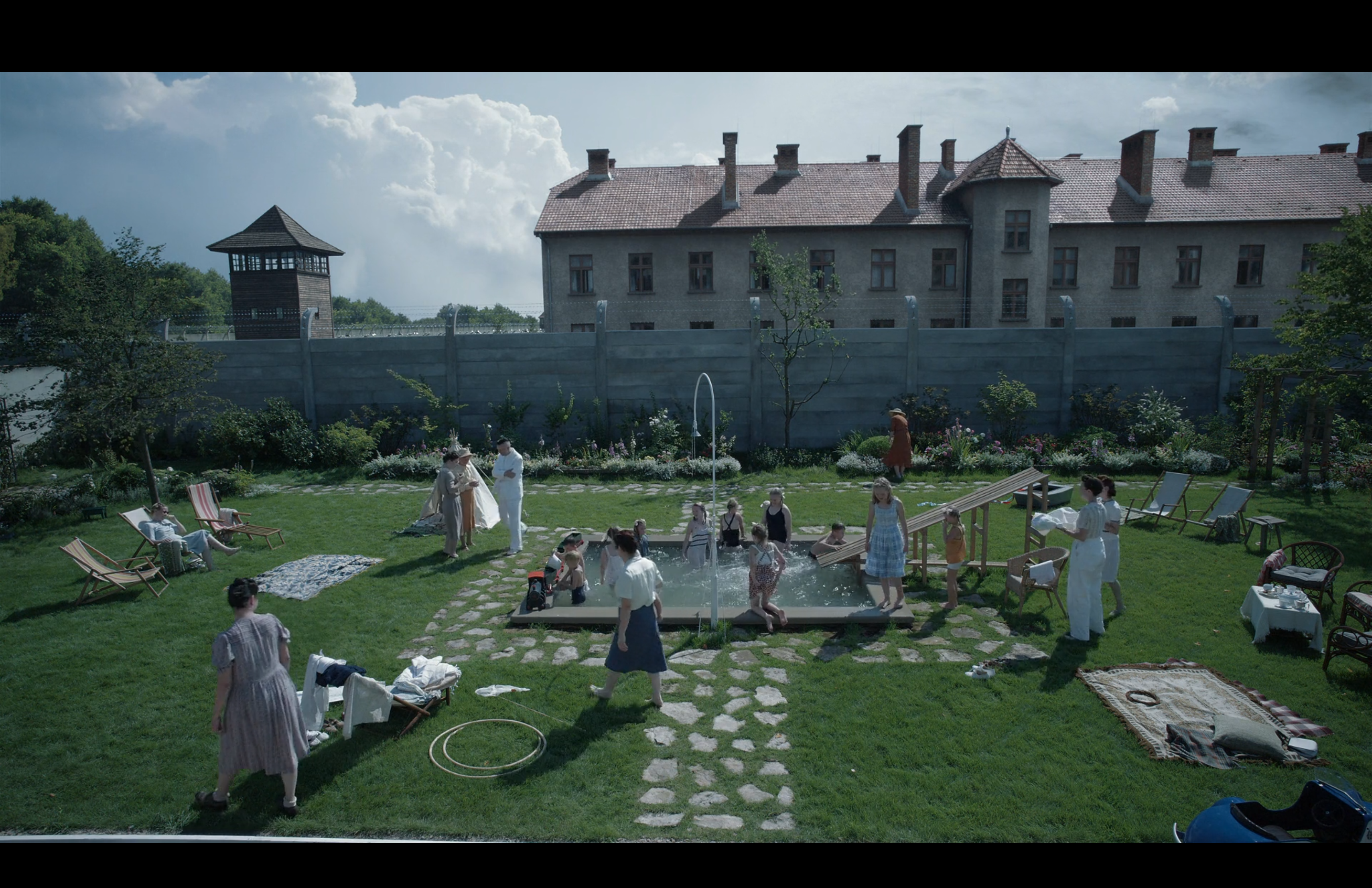
6. The Zone of Interest
“The life we enjoy is very much worth the sacrifice.”
The Holocaust film has been a staple of cinema ever since it happened. But there are no films that manage to capture it the way this film does. This film understands the horror of banality. This film understands that what’s truly more horrific than everything that happened are the people perpetrating it, for whom the events are just background within their everyday lives.
Jonathan Glazer is, as we know, a brilliant filmmaker. Every time he makes a film (Sexy Beast, Birth, Under the Skin), it manages to blow your mind in a new way.
There is not a single moment of violence in this film. We don’t ever explicitly see the camps, we don’t see the gas chambers and we don’t see the things we see in every other Holocaust film (even the ones that find different angles to show it, like Son of Saul). All we see is a family going about their daily lives. Sure, we see barbed wire fences and towers behind their house and occasionally hear the crackling of gunfire in the distance, but none of that ever makes its way onto the screen. And that’s what’s truly scary about it. They’re literally on the other side of Auschwitz, and yet they’re here having pool parties and wondering about whether or not they’re gonna have to move because of reorganization at work. The closest I think we get is maybe the moment where the father is at work and the engineers are showing him the blueprints for a gas chamber that can efficiently kill more people. That’s about as overt as it gets. And yet it’s all the more terrifying because of it.
To me, the scariest moment in the film is, early on, when the wife (the terrific Sandra Hüller) is sitting in the kitchen with her friends, looking at the paper, and she talks about a famous Jewish singer and a lovely mink coat she’s wearing. And then, like ten minutes later in the film, deliveries come to the house and she runs upstairs with hers, opens it up, and there’s the mink coat, which she casually tries on because it’s hers now (and then finds lipstick in the pocket, from the previous owner, and starts wearing it). The fact that we know everything that happened in between that casual remark to the moment where she has the coat and never have to see or be told a thing is one of the most powerful moments in film this entire year.
This film is not easy to watch. But no Holocaust movie is. That’s the point. And the filmmaking by Glazer really does not try to make it easier or more palatable. He even goes so far as to make that wall-breaking cut right at the end of the film to really drive that point home (it’s a breathtaking moment, because it underscores the themes of the film, but will also be misunderstood by a sizable portion of the audience).
This film is a masterpiece. Like a lot of films of its ilk (difficult films about difficult subjects), it’s hard to call it a favorite, but it’s also very easy to say that, pound for pound, this is one of the absolute best films of the year.

7. Poor Things
“Bella, it is dangerous to go out without me.”
“I have adventured it and found nothing but sugar and violence. It is most charming. I am fine.”
God, I love Yorgos Lanthimos. I love how his style and sensibilities are so weird and different from everyone else’s that a movie like this is considered ‘mainstream’ for him. But what’s great is that, while it is probably his most accessible film next to The Favourite, it’s accessible in a way that it opens up the door for people to delve further into his work, getting them acclimated to what his ‘normal’ is. Which is just wonderful.
The thing I like most about this film is that it’s a proper journey. From where it begins to when you get to the ending, you know you’ve been on a journey and you feel like it’s taken you down many different paths. A lot of movies, you sort of know going in roughly where the end is. This one, you have no idea. And yet, when you get there, it all kind of makes sense as to how we got where we are.
Where to begin with this one — first, the technical side. Taking the film from black-and-white to that distorted, colorful palette, to eventually proper, natural color. Then the German Expressionism of the sets at the beginning, eventually making them just… sets. All of it can be seen as a gimmick, but all of it underscores Bella’s journey. I love that we get to see the same location throughout the entire course of the film and see how it changes each time. Stunning cinematography and production design work there.
And then the acting — Emma Stone is a marvel. The limb from which she throws herself into this performance is something I can only imagine a few actors doing and pulling off the way she does. And Mark Ruffalo — he steals every single scene he’s in and it’s one of the funniest performances I’ve seen in a while. And Willem Dafoe, who is always great and manages to do so much under what looks like pounds of makeup. Plus Christopher Abbott, who shows up out of nowhere with 20 minutes to go and makes a lasting impression. But there’s also Ramy Youssef, Kathryn Hunter, Jerrod Carmichael — everyone in this movie is great.
This movie makes me happy because it means more people are getting to see Yorgos’ films. During a time when I feel like the mainstream doesn’t watch anything interesting or daring cinematically, having something like this to expose people to what proper auteur filmmaking is like (even at the relatively shallow end of that pool) is awesome.
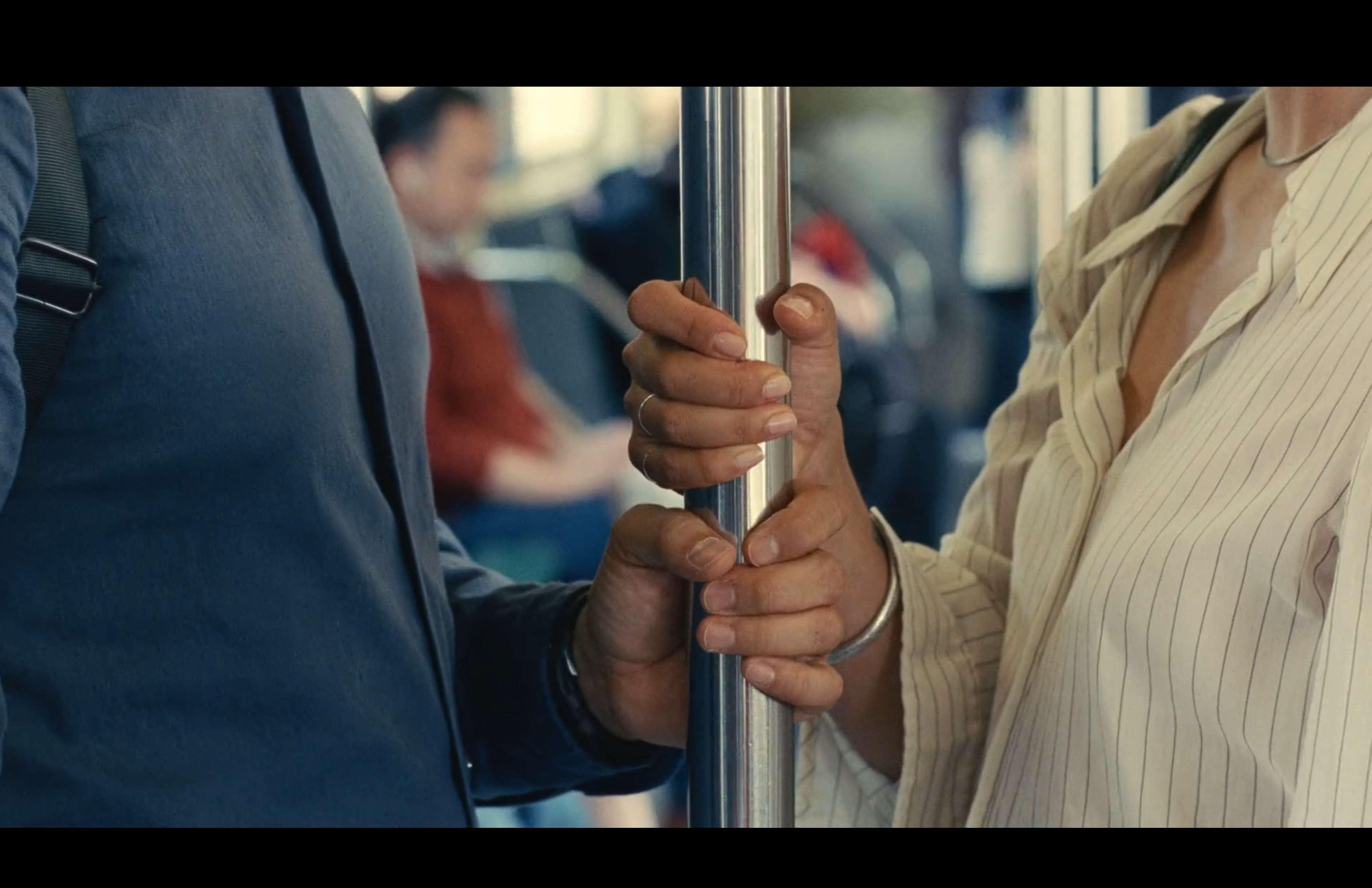
8. Past Lives
“I didn’t know that liking your husband would hurt this much.”
Every single year, there is a film that comes out (usually at Sundance or one of the early festivals) that everyone calls a masterpiece. And I always dread when those films finally come out, because my experience has been that people overrate them and the hype machine makes it so you almost have to say, ‘You know it’s not that good, right?” Which is more a critique of the culture, that ‘really good’ always seems to be heralded as ‘insanely great’. This was that film for 2024. And, unlike a lot of other years, I was very pleasantly surprised to see that this was every bit as good as it was advertised.
This is a film that works because it understands what does not need to be said, and understands the value of letting nonverbal communication (and the audience, which, unlike a lot of other films, it doesn’t treat as stupid, filling in the gaps). There is so much not spoken in this film and yet I dare anyone who sees it to not understand everything going on between the characters.
It’s such a simple story and yet it’s packed with emotion. I love how it never wastes a minute of screen time. The opening section with them as children is wonderful, and I could’ve watched another half hour of it, but the film wisely only gives you as much as it needs to before transitioning to them as adults. I also love how the film doesn’t fall into a lot of the traps films like this do. The story is about two childhood friends (who likely would’ve married had one of them not moved away) reconnecting as adults. And she’s now married to someone else and he’s still holding a candle for her. Most films like this would automatically make her husband unlikable. He’d treat her badly, or be a burden unto her, or something that would make it clear that she should be with this other guy. But instead, this film does none of that. (I even loved the scene where she goes out with her friend and comes home and the husband is playing video games. Which is a scene you see constantly. But here, he was just doing it because he was waiting for her to come home. And I love how it undercuts all those little things other films do.) One of the best scenes in the film is when her husband talks about how it’s like a movie and about all his doubts about what it means for their marriage. Almost no other film would give you a moment like that.
I love that the film never gives you any of the moments you expect to get. How all of those moments are right there and yet never happen (for a variety of reasons). And rather than being a story like all the others of its ilk, it’s a story about wondering what could have been if one or two moments in life had gone the other way. It’s a beautiful, beautiful film and I’m so glad this managed to find the reach it did and how so many people were (and will be able to) see it moving forward.
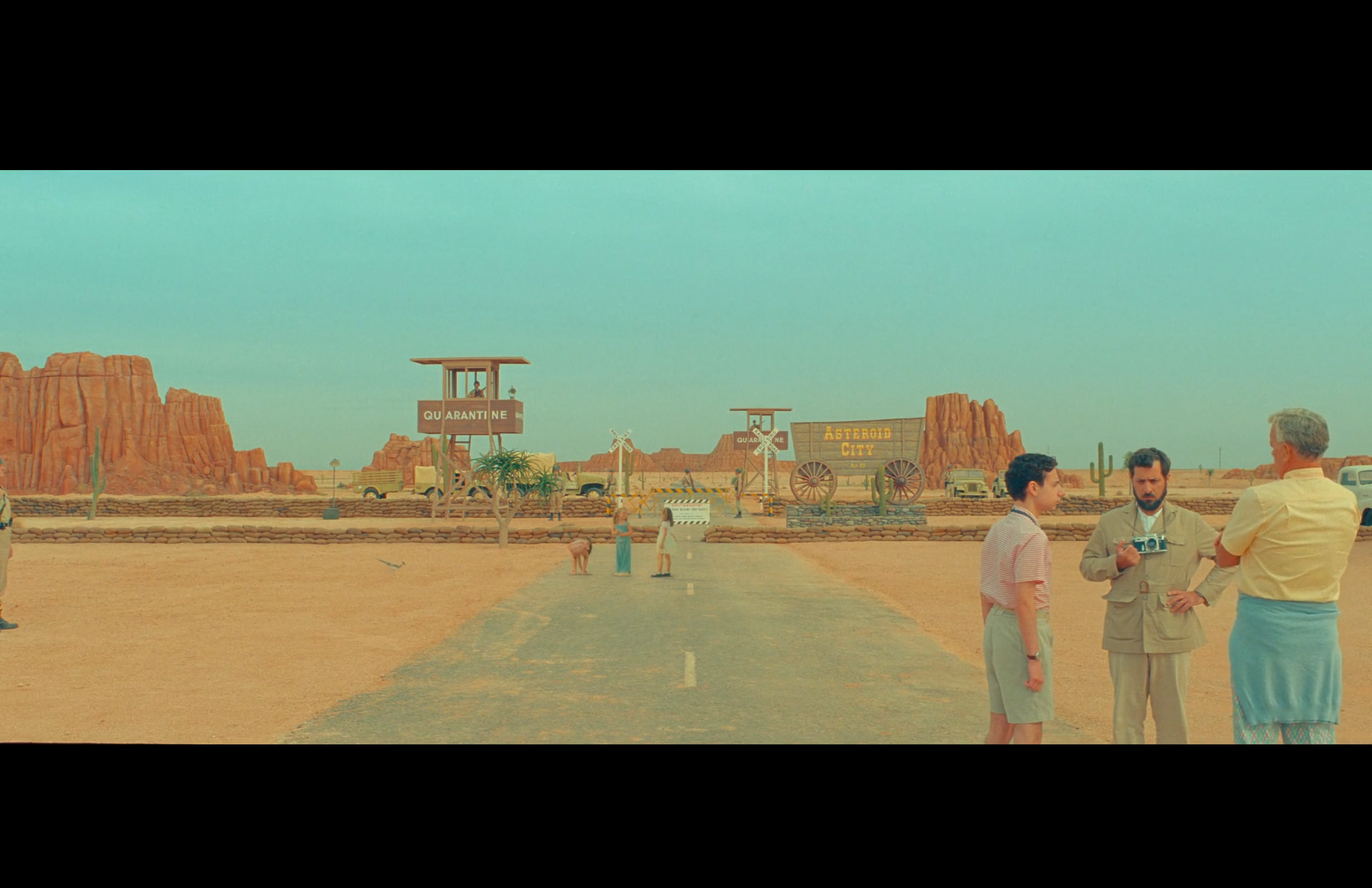
9. Asteroid City
“I still don’t understand the play.”
“Doesn’t matter. Just keep telling the story.”
One thing I love about Wes Anderson (or any filmmaker of his caliber, really) — I can watch one of his movies in the theater, feel a certain way about it, feel a certain way about how I feel it rests within the rest of his body of work, and then, at the end of the year, admit to myself that it was still one of the best things I saw that year.
This film — it’s an interesting step for him. I think a lot of people felt it wasn’t at the level of his absolute ‘best’ work, and I think it was more divisive than some of his other films as well. I would agree in the sense that I do like the majority of his other work more than this, but that’s like me saying To Catch a Thief isn’t in my top ten for Hitchcock movies. It’s a relative scale. I’ll still take this over just about anything else that comes out.
A few things I love about Wes Anderson — he seems to slowly be working on casting every current living actor and making them a part of his troupe. I also love how there’s a comfort level in this visual aesthetic he’s created in the past 15 years (really since Darjeeling he’s started heading in this direction, but it’s really taken off from Grand Budapest onward). He creates this reality within his films that’s so easy to slip into and enjoy. I also like how, within that, he’s trying a lot of different narrative things each time. This film is a documentary about the stage production of a play, in which the lives of the people putting on the play (its author, its director and its lead actor) are dramatized on screen, along with the actual text of the play (which are supposedly based on real events). It’s like the third act of Inception. He’s just going deeper within subplots. Plus, I’m not sure people even bother to pay attention to the specifics at this point, but between this and The French Dispatch, he’s started trying a lot more interesting camera movements and ways of staging his action, and it’s made the films all that much more entertaining to rewatch multiple times.
And all of this is before I even get into the fact that there are a lot of wonderful actors in this giving great performances (especially Jason Schwartzman… we should really be talking more about how good he is. Both in this and just in general), the whole western vibe is exactly up my alley, it has the typical Wes Anderson wit and humor to it, and there’s a complete out of nowhere musical number in this (which rivals “When a Cowboy Trades His Spurs for Wings” from The Ballad of Buster Scruggs for ‘best unexpected musical number of the past five years’).
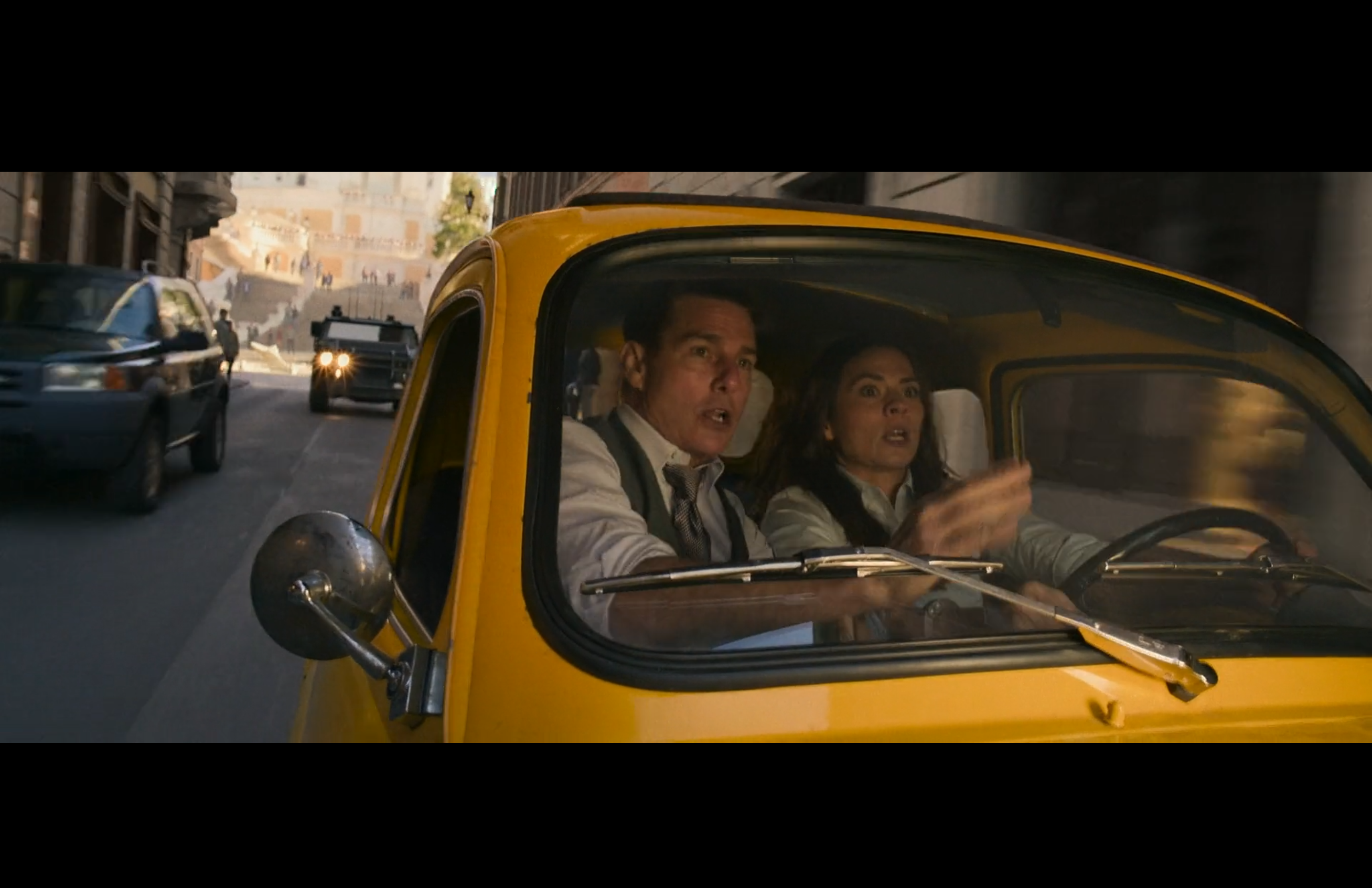
10. Mission: Impossible – Dead Reckoning Part One
“Our lives are the sum of our choices, and we cannot escape the past.”
This franchise started in 1996 with Brian De Palma. We are 28 years into it. There are two things that stick out to me: first, it’s crazy how there’s not a single bad film in the entire franchise, and second, how the films seem to get better which each new entry.
What’s more interesting is how the first three films in the franchise could not be more different, stylistically. Between Brian De Palma, John Woo and J.J. Abrams, we got three vastly different (all very good, in their own way) films. And then Brad Bird (who is, in a way, the Alfonso Cuaron of this franchise) shifted the entire franchise and essentially brought it on the path it’s been on ever since, which is, essentially — the Tom Cruise show. Cruise’s utmost commitment to excellence has led to this series consistently outdoing itself. What other franchise manages to make a Top Ten list for the first time in its seventh entry?
The franchise has long been a bastion of great (and practical) action sequences, smart writing, never settling for the easy way out and top tier craftsmanship on every level. I don’t think you can name more than three movies that’ve come out in the past 20 years that can say they were influenced by Buster Keaton and the comedians of the silent era and actually mean that in a tangible way (and not just ‘we said it because it sounds good and because there’s vaguely a sense of slapstick to the action sequences we had the CG team storyboard for us’). You can see dedication to making these films the very best they can possibly be in every single frame of the film and an understanding of what makes the genre work.
I also love how this film, while playing on the tropes it’s been using since the first one, still manages to make them feel fresh each time. It’s like a comedian that knows they have a certain turn of phrase or punchline up their sleeve. So they play with when and how to bring it out. Watching this franchise find new and interesting ways to pull off the mask moment, or Cruise running, or whatever insane stunt he’s trying next — it keeps getting better. I also love how the credits to the film don’t even roll until 30 minutes in, how it’s almost three-hours long (and a Part One of a two-part film) and how you can get two hours into the runtime without ever once feeling like it’s dragging for even a second. It’s a masterpiece. This franchise continues to be a marvel and an outlier and is, pound for pound, consistently one of the best film franchises of all time.
– – – – –
11-20:
Air — There’s so much to talk about with this movie. From the fact that it’s another Ben Affleck and Matt Damon film, to the fact that it’s part of a subgenre populating 2023 that is ‘films about brands’. And not like Barbie. That’s an adaptation of a product. I’m talking about films about the brands. This is a story about Nike, and how the brand became famous. Other films from this year following similar trajectories: BlackBerry, Tetris, The Beanie Bubble, Flamin’ Hot… there were a lot of them. I do feel a certain way, in the macro sense, about the fact that all of those films are essentially masturbatory exercises promoting capitalism. But also, in the micro sense, I really enjoy this as story. It’s so goddamn entertaining. And it’s at least is shrouded enough in the sports movie and the biopic genres to make me not so upset about the capitalism porn aspect. Damon is one of those actors, like Tom Hanks, where he’s always just so damn good and consistent that you take him for granted. And Affleck gives another quietly great performance (which he’s also been doing consistently, so long as the material is up to snuff). Jason Bateman is also really great in this, the writing is really good, it’s got the right type of energy to it — this is one of those rewatchable movies that I live for. The kind I’ll catch on TV midway through in five years and just keep watching because it’s so damn fun.
American Fiction — The thing that surprised me most about this film is that, once you know the premise, you know everything this movie is gonna be. It’s not a new premise. And yet, despite that, the movie works. It works really well. It’s basically Bamboozled for people who read The New Yorker. But for me the enjoyment doesn’t come from the overarching plot of the story but rather in the film’s quieter moments, where the family drama is on play. Jeffrey Wright, as always, is tremendous, as is Sterling K. Brown. The two of them as brothers light up every scene they’re in. And the film manages to make scenes you’ve seen before feel funny (them cursing at the guy on the beach as they’re dumping their sister’s ashes, or the scene where he meets the producer in the restaurant). I find that I don’t need this movie to break any new ground, because not only does it manage to be perfectly great on its own, but the ground this movie is treading is a message that has been trying to be told for decades now, seemingly to no avail. So any high profile movie that can once again put this in front of people’s faces in the hopes that maybe it’ll get across and do something is just fine by me.
Are You There, God? It’s Me, Margaret. — You don’t expect an adaptation like this to even be made nowadays (given how ‘plotty’ most films for and about teenagers tend to be, and how books as classic as this one — this was written in 1970 — tend to not adapt as well to today’s era of filmmaking), and more so you don’t expect it to be made well. But this film completely understands what it is and needs to be and it absolutely is an underrated masterpiece. Written and directed by Kelly Fremon Craig (whose first film was the amazing Edge of Seventeen with Hailee Steinfeld, which also feels like it’s fallen into the ‘immensely underrated and underseen’ category), it’s a film that knows the key to a good movie for teenagers (and about teenagers) is to just be real. Make the film feel lived in and comfortable, and that will make people go back and watch it again and again, rather than what most films nowadays do, throw a lot onto it for the initial watch, and then they get forgotten about as a dozen other films just like it come along. There’s something about this movie that feels like that age period. I can’t explain why or how (especially given that none of this remotely correlates to my experience at that age), but it does. And I found myself coming back to this one throughout the year because of that. There’s a comfort food aspect about this movie and that’s what I think makes it so great.
Beau Is Afraid — Ari Aster, man. That guy. Incapable of making an uninteresting movie. This one is bound to be the most divisive of his efforts. Especially coming off Hereditary and Midsommar, two horror films with (not so hidden) undertones of comedy. This one is more a comedy with undertones of horror. It’s a three-hour surrealist movie about an anxiety-ridden man trying to go visit his mother — if you took Kafka and Woody Allen and had the guy who made Hereditary and Midsommar direct it, you would get this movie. It’s absolutely insane in the best way possible. It’s also one of those films where either you’re gonna go with it immediately or it’s just not gonna be for you. You have to respect a movie like that. I am very much in the former camp. I enjoyed the hell out of this. Joaquin Phoenix is firing on all cylinders, Aster really allows the movie to breathe, extending the anxiety trip as long as he can (leading to an absolutely bonkers third act, as all his films tend to have), and really just allows the weirdness to take over more than he did in his previous two films. It’s not for everyone, but for those it’s for, they’re gonna really enjoy it.
The Boy and the Heron — There’s always something magical about a new Miyazaki movie. After Wind Rises, it seemed like we wouldn’t get any more. So being able to get this is truly a cinematic miracle. There’s something about his films that’s just different from all others. And that’s what makes him great. This one is very much in line with his previous works, thematically, though it definitely feels more thoughtful and complex. It feels like someone who knows this is going to be their final film. It’s a beautiful mix of an old man looking back over his life and the childlike dreams of someone who never grew up playing out simultaneously. And it’s a gorgeous, gorgeous film, and a perfect inclusion into Miyzazki’s absolutely flawless filmography. I’m so happy I get to watch this man’s films again and again.
The Boys in the Boat — There’s something to be said about safe movies. George Clooney, apart from when his films are overtly political, has largely made ‘safe’ movies. They’re not flashy, they’re not trying to be complicated. They’re just solid pieces of work. And that’s what this is. A period sports biopic that’s simply about a bunch of people who join a crew team and row their way to the Olympics. It’s not gonna surprise you, but it is gonna entertain you. And I appreciate movies like this. Because this is the type of movie you see once and go, “Yeah, it was good, but (Past Lives, Zone of Interest, etc).” Then, three years later, this will be the movie that, if it’s on HBO or something (assuming HBO even exists in three years and the world isn’t just a bunch of paid streaming services), you’ll just throw it on because it’s an easy movie to put on while you’re cooking and doing laundry. The world needs movies like this.
If You Were the Last — There’s always one movie that absolutely no one saw that I fall in love with and wonder why no one else managed to discover it. This is that movie for 2023. I went into this with no expectations whatsoever. “Space rom com with Anthony Mackie and Zoe Chao.” I like both of those actors, I was assuming a perfectly decent, throwaway little movie. So imagine my surprise when I walked into a smart and inventive comedy that’s not afraid to try things and be different, that also packs a secret emotional punch behind it. Not to mention a great central premise — two astronauts who’ve been stranded in space for three years with no real hope of rescue and have since become best friends (because, as they say in the film, they are literally each other’s world). And then one day they ask the question: “what would happen if we slept together?” It’s just such a great premise, and the film capitalizes on that perfectly. A lot is owed to the great performances and chemistry from Mackie and Chao, but a lot is owed to the writer, Angela Bourassa, who finds fun ways to add wrinkles into the premise and deepen the story to make it more than just another rom com. I found myself really invested in this one and really liked it a lot, and I’m very happy to have this one as something to revisit and enjoy.
Indiana Jones and the Dial of Destiny — The sequel we didn’t want yet also somehow needed. The proper sendoff to the Indiana Jones character that had to happen after Kingdom of the Crystal Skull (which isn’t a bad movie… it’s actually quite good. It’s just not the first three). A great extension of the Indy character, taking him into his 70s, retired, grumpy and (eventually literally) out of time. It brings back the fun action sequences with clever twists the original trilogy had, crafts a fun adventure that deftly handles the character (and actor) as they are now while also recalling all the great adventures of the past, and bring the nostalgia around but doesn’t hang its fedora on it the way most franchises would. It’s not a perfect film (Antonio Banderas is wasted, and I do have questions about the excessive editing in the action sequences, even if no one can stage the way Spielberg does), but the things it does well it does really well, and the coda of the film is a truly fitting finale for the character. Plus, it’s Indiana Jones. It’s like comfort food. Even if it’s not Last Crusade or Raiders, it’s still Indy. (Also, food for thought — I think the best version of the past two Indy movies would have been with Mangold directing Kingdom of the Crystal Skull and Spielberg directing this one. Because Mangold would’ve been able to tell Lucas no and made some of that story better and Spielberg could have taken the (admittedly very well-put-together) action sequences from here and really made them soar through his brilliant staging and affinity for longer-take action sequences that don’t rely on editing.)
No One Will Save You — I love when you put on a movie that has a lot of buzz, but know nothing about it. Especially when, like this one, it grabs you from the jump. I was hooked instantly with this, partly because it stars Kaitlyn Dever, one of three-to-five best actresses of her generation (a generation that, by the way, also includes Saoirse Ronan, Florence Pugh and Hailee Steinfeld, which is saying something) but also because the film immediately announced itself as a dialogue-free film (not a silent film. Similar to, say, Mr. Hulot’s Holiday. Only more like M. Hulot’s Close Encounter). The first 20 minutes of this film are so rich they could be a perfect short film if it ended there. You could show those 20 minutes to anyone and I guarantee they’ll become invested. Truly some of the best 20 minutes of cinema I’ve seen. Though ultimately what’s most amazing about this film is how it sustains its story. Because the story is very simple. It manages to stay hyper-contained in a way that is almost unthinkable for a film nowadays. It also manages to not give in to the baser instincts of its genre either, and continues to find ways to both elevate and innovate within that genre. It’s also always exciting to me when I can watch a movie do its thing and also be able to go, by the end, “Oh wow, they fully went there and did that.” That ending is one of those decisions that takes a good film and makes it great. The kind of ending you don’t see much of anymore because everything is sanitized and studio-driven most of the time (because they’re looking to franchise it or world-build).
Pinball: The Man Who Saved the Game — This was one of the first films I saw this year and remains one of the best. I love this movie. It’s so damn watchable. It stars Mike Faist, who is an absolute star (most people first saw him as Riff in Spielberg’s West Side Story and now know him from Challengers), and it’s based on a real guy. The film is narrated by the guy (or rather, an actor playing the guy), and there’s an interesting narrative twist there, as it’s set up as a docudrama with an actor playing a real person telling their story and us flashing back to the story as they narrate it (and occasionally show up in the film). The story is that pinball, at one time, was illegal in the state of New York. And the film is the story of how this guy helped keep it from being outlawed, which allowed it to become as widespread as it became. But also, that’s not the full story, because so much of it is really about the story of how this guy met his wife. And that part is just delightful. The chemistry between Faist and Crystal Reed is just off the charts, and the entire film is fun and playful and just works. This is one of those ‘good time’ movies for me that I know I’ll be able to go back and enjoy again and again in the future. Truly it’s one of the best things I saw this year.
– – – – –
Tier Two:
- Anatomy of a Fall
- The Caine Mutiny Court-Martial
- The Creator
- Dicks: The Musical
- Dream Scenario
- Dreamin’ Wild
- Dungeons & Dragons: Honor Among Thieves
- Elemental
- How to Blow Up a Pipeline
- The Iron Claw
- John Wick: Chapter 4
- Maestro
- Master Gardener
- Napoleon
- No Hard Feelings
- Priscilla
- Saltburn
- Sanctuary
- Spider-Man: Across the Spider-Verse
- Teenage Mutant Ninja Turtles: Mutant Mayhem
Dream Scenario is, as a concept, a dream scenario for me. They had me at the premise: what if everyone in the world suddenly started dreaming about Nicolas Cage? Brilliant. And Cage — this isn’t the Cage of the past decade, where the majority of the work was for hire, and even if he was trying to have fun, the material wasn’t quite there. This is him fully back in his element. You know from the minute you see him on screen, with that very specific look, that he was dialed in for this one. It’s some of the best work he’s done. And, while the premise is one thing, the film itself is really about fame and how this boring, self-centered guy finally gets the recognition he’s been looking for all his life. I love the way the film doesn’t just rest on the premise itself but instead twists it into something else and shows the consequences of fame. I’m so happy that Cage is fully back making interesting (and good) movies that people are watching. Spider-Man: Across the Spider-Verse is the sequel and second part of the trilogy. It doesn’t feel as revolutionary as the first one did (just because now everyone’s been copying the animation style), but it’s a really solid film. I feel as though the first film was slightly overrated and this one is slightly underrated. Either way, the trilogy is gonna be a great series of films that are easy to watch, easy to enjoy, with great music, fun storytelling and great animation. You can’t ask for more than that. Speaking of great animation — Teenage Mutant Ninja Turtles: Mutant Mayhem. My god. What’s crazy is that there was just a Ninja Turtles movie last year (which was… fine). I didn’t expect anything out of this when I put it on. Then I saw it was written by Seth Rogen and Evan Goldberg. Then I found myself going, “Wow, this is fun.” Then I found myself going, “Wow… this is great.” Legitimately this was one of the best times I had watching a movie this entire year. Everything about this movie was incredible (including the animation style, which owes a lot to Spider-Verse).
No Hard Feelings is yet another example of the power of the rom com genre when it’s done right. This movie somehow pulls off two genres at once — the raunchy comedy and the rom com. Both of those genres have felt overdone (and… dead) the past few years, yet this one manages to make it all work. The key is Jennifer Lawrence being completely game for everything. Not every actor would’ve gone all in on a role like this, and she does a wonderful job. The other key is the absolute discovery of Andrew Barth Feldman, who — and I am not overstating this — gives one of the best performances of the year. He is so goddamn good. The moment you know this movie truly works is when he sings “Maneater” at the restaurant. The fact that moment lands as well as it does is a complete testament to how well this film is put together. What’s even more interesting about it is how absolutely generic its premise is. It’s such a well-worn premise that there’s almost no way they should’ve gotten the movie they got out of this and yet, here we are. This is one of the great surprises of the year and truly one of the best experiences I had with a movie this year. Hopefully this convinces people that the rom com can still be made well. Elemental is above average Pixar. It’s not great Pixar, but it’s also not middling Pixar either. This is in that realm of ‘it feels reminiscent of their other stuff, but it’s not a sequel and is still very good’. This has shades of Inside Out and Soul, but is its own thing, and works on its own. I like that they didn’t just settle for the ‘elements’ premise of fire and water and told a more complex story. Almost no other studio would have allowed this story to be about the immigrant experience the way this one does. That aspect adds that extra depth that allows the movie to be better than just a concept. In a year with some really great animation, this one may have gotten a little bit lost in the shuffle, but it’s a very respectable entry in the Pixar catalogue and continues the visual excellence they’ve shown throughout their career.
Sanctuary is one of the hidden gems of 2023. Not dissimilar to the movie Piercing from a few years ago (which also, coincidentally, is a two-hander co-starring Christopher Abbott). Though whereas that was about a businessman who hires a prostitute in order to murder her, this is about a businessman who hires a dominatrix. The dominatrix is played by Margaret Qualley, and the film is about their relationship and what happens when he tries to end it. It’s a great acting piece, both leads are amazing. I do highly recommend people check this one out, because it’s an experience (also shout out to the film Fair Play from this year as well, which also deals with relationship power dynamics, albeit in a much different way). Napoleon is Ridley Scott. And that’s all you need to know. Pretty sure the man’s only made like two less than really-solid movies in his career (and even those are watchable and perfectly okay movies). This one, however, falls into the category of something like Kingdom of Heaven, where the version that was released in theaters is clearly not as good as the version he intended to make from the footage he shot. The version that came out is a very good movie. But I know there’s more there, and I very much look forward to seeing the 4-hour cut of this movie, because I suspect that version may actually climb higher on this list when it comes out. But, for what it’s worth, right now — this is just a visually resplendent biopic with great performances from Joaquin Phoenix and Vanessa Kirby and amazing production values across the board. Ridley knows what he’s doing. And I hope this man has at least five more movies left in him, because he’s got one of the best filmographies anyone’s ever had.
How to Blow Up a Pipeline is one of two titles on this list (with How to Have Sex) whose title reads like a manual more than a movie. But this is a movie. Directed by Daniel Goldhaber, director of Cam (very good movie worth seeing), and it’s an ensemble about a group of environmental activists who plan to… well, you can figure it out. The film is great. It’s an ensemble thriller that follows each of the characters both separately and together. And it is thrilling. I’m telling you, you will get invested in this. It’s insanely well-edited. It has an urgency to it that grounds you and really draws you in. It’s one of the best movies I saw this year and is a hidden gem. Maestro is such an interesting film. Because it’s so easy to see this as a Bradley Cooper vanity/Oscar bait project. Biopic of Leonard Bernstein, decades-spanning, transformative makeup — it’s almost a parody of an Oscar nominee. And it is that, sometimes to a detriment to the overall film. On the other hand, the filmmaking here is astounding. To the point where it actively overcomes what I found, at times, to not be a very interesting movie. But man, the things Cooper does with the camera — framing and cinematography… it’s a great piece of work. And I think a lot of that gets lost in the rest of the whole deal. Granted, this will always be a movie I respect more than I love, but I do appreciate the amount of effort that went into it, because the film looks incredible. Dungeons & Dragons: Honor Among Thieves is one of the delights of the year. It’s so nice when a movie comes out that surprises everyone for the better and people actually go see it, so everyone gets to share in that excitement. Nobody had any expectations for this whatsoever. Then you watch it and go, “Wait, not only was that really fun, it’s actually really great.” The minute the name Jarnathan is spoken in the first five minutes, you know you’re in for a good time. You don’t really get a lot of movies like that anymore at this level. But the whole movie is so much fun (and knows what it is, which helps). Everyone in it is clearly having a great time. It uses the surprises up its sleeve really well. It’s not reinventing the wheel, but it is giving you a side of the wheel you don’t get all that much, and in today’s market, that’s enough.
Dicks: The Musical is one of the great surprises of 2023. I had no idea what this movie was going to be as I went into it, and they had me from the opening titles, where they talked about it being about two gay men “bravely” playing heterosexual men. This musical (it’s a musical, by the way. About dicks) is so over-the-top and so brazenly ridiculous that it’s not going to be for everyone. But the people it is for — they’re gonna enjoy the shit out of it. I found myself laughing a lot at the ridiculousness of it all, from the hypermasculinity of the protagonists (juxtaposed by the musical numbers proclaiming said hypermasculinity) to everything Nathan Lane and Megan Mullally are doing (Mullally especially. Everyone came to play for this one). This movie is fun as hell, and somehow I like it more knowing not everyone is going to feel that way about it. Saltburn is one of the signature films of the year. A real lightning rod of a movie. I’m still not quite sure what to make of the whole thing, but the more I think about it, the less I think I care. I feel like I had a great time with it and that’s all that matters. About five minutes into the movie, you pretty much know everything it’s doing and is going to do. Once you know that, the rest is just going along for the ride. And the movie doesn’t disappoint. It gives you all of the brilliance that is Rosamund Pike’s character, Richard E. Grant doing Richard E. Grant things, memorable moments (the bathtub, the grave, the dance) and the whole thing looks fantastic as it does it. I’m not sure what more I could ask for out of a movie. That’s why I don’t even care if I think it’s good or not. It works. It’s fun. It’s an experience I won’t soon forget. That’s all you need. John Wick: Chapter 4 is the next one. What can you say about this franchise at this point? It’s reached Fast and Furious territory by now. Each successive one gets more ridiculous, does crazier shit, and yet there’s a baseline of quality and entertainment that makes it fun every time. At a certain point you don’t even remember which movie is which past a set piece here and there. But it doesn’t matter. They’re great and all you want is another one. That’s cinema.
Dreamin’ Wild is a film from Bill Polhad, whose previous film was Love & Mercy, one of the great films of the past decade. This, like Love & Mercy, is a music-related film. It’s about Donnie and Joe Emerson, two brothers who recorded an album as teenagers on their farm in 1979. The album went almost totally unknown until almost 30 years later, when a record collector found it at an antique shop and began writing about it online, leading to it becoming an underground hit. The film is about the brothers, now adults, one a contented rancher and the other still chasing that musical dream, coming to terms with the fact that the album they wrote, seemingly in another lifetime, is now something people care about. Oh, and I should mention that the brothers are played by Casey Affleck and Walton Goggins. This is a quiet, great little movie that doesn’t try to shoot for the moon but instead provides a beautiful, grounded experience about real people dealing with something so ephemeral as overnight (minor) fame. It’s one of the hidden gems of this year, and I hope people seek this one out. Anatomy of a Fall is such a great film because of how ambiguous it is by design. The film is, as its title suggests, quite literally the study of an event. There are no tricks here. There’s no sudden third act reveal. The opening ten minutes include the fall. The rest of the movie is the investigation and trial and aftermath of it, as everyone tries to figure out if the guy fell or was pushed by his wife. And the beauty of the film is — it never tips its hand either way and lets the audience decide for themselves. It’s a great piece of work, anchored by an incredible performance from Sandra Hüller (who has two amazing performances this year). Don’t let the subtitles dissuade you, this is one of the most gripping movies of the year.
The Creator is a marvel. It’s an original concept sci-fi movie that is designed for adults looking for smart sci-fi that’s not mindless entertainment and also designed to be a singular film. They’re not building a universe or starting a franchise. It’s just a one-off, good movie. And that is something they just do not make anymore. Good on Gareth Edwards. Dude’s crafted an solid filmography thus far (Monsters, Godzilla, Rogue One and now this). The premise is good, too. War between humans and A.I., undercover soldier loses his wife (who is working with the A.I. and may also secretly be its head) and then is recruited back to uncover a ‘secret weapon’ the A.I. have… which is a child. And then he and the child end up on the run as he tries to figure out what happened to his wife. There’s so much good here, and as I watched it I found myself very pleased with the fact that the film was telling its story on its own terms and not on the terms of a studio or an executive. We need more original sci-fi with actual storytelling instead of world-building and excuses for CGI set pieces. Master Gardener is Paul Schrader continuing his ‘God’s Lonely Man’ theme, which he’s used going all the way back to Taxi Driver. He’s been using this a lot lately, with First Reformed (quite literally God’s Lonely Man) and The Card Counter. This one, I feel, may be the best of the three. Or at least is the most interesting of the three. Narratively it’s the same as his other stuff — slow burn type of film led by voiceover of a singular main character with a very specific job, culminating in violence in the third act — but I found myself absolutely captivated by it. I loved Joel Edgerton’s performance, I loved the subplot with Sigourney Weaver and her grandniece — the whole thing just worked for me. If you’ve seen a Paul Schrader film before, this isn’t going to break any new ground for you, but it’s still a very fine piece of work by a guy who knows this territory very well. This is, quite literally, a master gardener at work.
The Iron Claw is a movie that I almost cannot believe got made. Here’s a real life story that’s so sad that the movie actually had to make it less sad in order to get people to watch it. That’s insane. The story of the Von Erich family is one of the tragic sports stories out there, and this movie doesn’t pull any punches in telling it. It also doesn’t sanitize it or embellish it. Which somehow makes everything hit that much harder as you watch it. It’s also filled with astounding performances, particularly from Zac Efron, Holy McCallany and Maura Tierney. It’s such a terrific film, and one of the saddest endings to a film I’ve seen in a long time. Priscilla is Sofia Coppola telling the other side of the Elvis coin from the orgy that was Baz Luhrmann’s version. This is told from Priscilla’s perspective, and is essentially a movie about a toxic relationship brought on by an older man preying on a teenage girl. Coppola does a great job of subtly showing the power dynamic between the two without ever overtly stating it and also really lays in the loneliness of what it’s like being Elvis’ wife. It’s one of her best films, and makes a great double feature with Elvis. The Caine Mutiny Court-Martial is, sadly, William Friedkin’s final film. But what a way to go out. It’s essentially a TV movie/play-on-screen version of the story. It takes away all the frills and pretenses and just gives you the meat and potatoes. Just straight up a trial movie. Great performances from Kiefer Sutherland (as Captain Queeg), Jason Clarke (as the defense attorney) and Lance Reddick (in one of his final films), and just a great example of a master filmmaker knowing that less is more.
– – – – –
Tier Three:
- All Dirt Roads Taste of Salt
- Anyone But You
- The Blackening
- Boston Strangler
- Bottoms
- The Burial
- The Color Purple
- The Covenant
- Dumb Money
- Ferrari
- Flora and Son
- The Hunger Games: The Ballad of Songbirds and Snakes
- Joy Ride
- May December
- The Old Oak
- The Peasants
- Society of the Snow
- Suzume
- Theater Camp
- They Cloned Tyrone
Anyone But You is a proper rom com. A rom com in the tradition of all the stuff they don’t make anymore. Those Kate Hudson/Matthew McConaughey early 2000s movies? This is that. Starring the two perfect leads for it, who have great chemistry. The writing is fun, the movie is taking itself exactly as seriously as it needs to. This is the kind of movie that will benefit from people finding it in a year of two, after everyone’s forgotten about it (and I don’t even think it’s taken that long. People are already onto it). The majority of people watching this are gonna realize how much fun it is. Hell, it even has the end credits montage where all the main characters are filmed singing a pop song after they shoot scenes. This is rom com perfection, and don’t let anyone tell you different. This is exactly the type of movie that needs to come back to prominence. Society of the Snow is a J.A. Bayona film (he of The Impossible, A Monster Calls and The Orphanage fame, and Jurassic World: Fallen Kingdom infamy) about the Chilean Rugby team whose plan went down in the Andes and the story of those that survived. Most people know it under the title Alive, which is the name of the book about it and the 1993 film it was previously adapted into. Like The Impossible, it takes a very sudden, cataclysmic event (using great effects) — which is only a small portion of the film, as the film is about the aftermath and not the event itself — and then focuses on everyone doing their best to get out alive after the event. It’s a very good piece of work and one I’m happy was made in the native language of the people who actually experienced it.
Theater Camp is one of those movies that’s really for theater kids (clearly written by theater kids) but is so funny that it’ll appeal to anyone. It’s a mockumentary about a failing camp whose matriarch falls into a coma, putting it in the hands of her dimwit, wannabe-influencer son (the brilliant Jimmy Tatro, best known for the first season of American Vandal), who has to help try to save it from foreclosure. We follow the counselors and the students as they prepare their annual slate of shows. And oh my god, is it funny. This is a finely-tuned comedy that keeps revealing more jokes each time you watch it. Definitely one of the best comedies of the year and a movie everyone should see. Dumb Money is a film based on the GameStop stock situation, where a bunch of regular people bet against billionaires and made a shit ton of money, to the point where capitalism turned against them. It’s a hugely important story (because at its core it’s about how fucked up the system is, as it purports to be a system where anyone cane make it but then when the wrong people start making it, the system turns against them to protect the ones they want to be successful). The film itself is kind of a Social Network/Big Short/I, Tonya hybrid (not wholly surprising, as its directed by Craig Gillespie, who directed I, Tonya and the book it’s based on is by Ben Mezrich, who wrote The Social Network), and doesn’t work 100% of the time. But it’s fun and timely and does what it needs to in order to be both entertaining and get its message across. It’s a solid piece of work. Suzume an anime from Makoto Shinkai, director of Your Name and Weathering with You. It’s about a teenage girl, haunted by the disappearance of her mother, who discovers a series of mysterious doors spread all over Japan (whose openings seem to bring about natural disasters) and goes along with a mysterious boy whose job is to close these doors. It’s… as you can tell by his previous films… a beautiful, visually resplendent film with a strong emotional core. Good filmmakers make good films. This is another example of that.
They Cloned Tyrone is a great high-concept (blaxploitation) sci-fi film. A three-hander, ostensibly, with John Boyega, Jamie Foxx and Teyonah Parris (as a drug dealer, a pimp and prostitute, respectively). It’s about them discovering a conspiracy in their town after Boyega gets murdered one night and then… just shows up the next day as if nothing happened. That’s really all you need to get into the film. It’s a unique and entertaining piece of work and one of the films from this year most people ought to seek out if they haven’t already. Boston Strangler is part of a great lineage of a dwindling genre — the journalism film. It’s about the two women who helped connect the murders of the titular strangler and all the sexism they encountered along the way in what was a male-dominated profession. Starring Keira Knightley and Carrie Coon, it’s weird to me how quietly this film came and went. It’s not Spotlight, but it’s really solid and worth a watch, if only for the two leads alone. It also has Chris Cooper and Alessandro Nivola in it. I don’t know a single person with good film taste who doesn’t hear those names and think, “Why haven’t I seen that yet?” The Burial is the kind of movie they just do not make anymore. It’s a straightforward people-pleaser, unabashedly sentimental — the kind of movie Frank Capra would’ve made. And it’s a trial movie. Everyone knows how I feel about trial movies — they are always interesting. Plus you have Tommy Lee Jones and Jamie Foxx (and Bill Camp as the antagonist!) — what more could you want out of a movie? Also directed by Maggie Betts, who made the incredible Novitiate and finally gives us a follow up to that.
May December is Todd Haynes returning to melodrama with Julianne Moore after Far from Heaven. This one, though, rather than being a pastiche of Douglas Sirk, this is more a wry soap opera. The basis: Julianne Moore was a high school teacher who started a relationship with one of her students. It cause national headlines and she went to prison. However, she married him and now, here they are, years later with kids about to go to college themselves. Meanwhile, Natalie Portman is an actress about to play a character in a film based on Moore who comes to town, looking to research the part. And the film is this blend of what Hollywood and actors do to real people when looking to play them, mixed with a look into the marriage/relationship of the former teacher/student post-scandal, mixed with that ‘double’ narrative, where you slowly start to see Portman snaking her way into Moore’s life and slowly becoming more and more like her. There’s a lot here, and a lot of it is good. Particularly Charles Melton’s performance as Moore’s husband/former student. There’s a scene where he’s smoking pot on the roof with his son that is jaw-dropping. The film has the flashy two lead performances, but it’s Melton who steals the film. I know some people have taken issue with the tone (especially with the over-the-top melodrama score — adapted from a 70s score, so it really stands out — and moments like “I don’t think we have enough hot dogs”), but there’s a lot more good here than bad, and Haynes remains a filmmaker who always gives you something worth seeing and talking about, making him a continued vital voice in cinema.
Joy Ride is a film that’s easy to call the “Asian-American Hangover” film. And you know what? If that gets people to watch it, I’m okay with that. But this is like the movie Girls Trip in that it’s a comedy for a group of people who don’t get to be the stars of these movies. This is a raunchy comedy starring Asian women. And you know what? It’s fun as hell. It’s ridiculous, it’s fun, and it’s got all the same flaws as the same raunchy comedies that star white people the rest of the time. It’s also got a huge heart on it and is honestly one of the better films I saw this year. The Covenant is a Guy Ritchie movie. Which they seemingly knew no one would know, so they had to release it under the title “Guy Ritchie’s The Covenant.” It’s a departure for him in that it’s a straight war movie. It feels kind of like when Doug Liman made The Wall (another good movie no one remembers). It’s an interlude from the things he’s normally known for making. And as such, it’s destined to be forgotten. Which is a shame, because it’s a really solid movie. Stars Jake Gyllenhaal and Dar Salim. Salim is a local interpreter for American soldiers who goes well out of his way to save Gyllenhaal’s life after he’s injured in a roadside attack (and is being hunted by the Taliban). It’s a strong and tense war film and very much worth seeing. It’ll never be spoken of on the level of Ritchie’s best films, but it’s a really fine piece of work.
The Peasants is an animated film by the team that did Loving Vincent, one of the most underrated animated films of the past decade. That film was memorable in that every frame of it was hand-painted. Which they also do here. They shot the film live-action and then animated each of the frames, hiring over a hundred painters who created oil paintings of every frame of film. The story is based on a Polish novel that won the 1924 Nobel Prize, about the residents of a village over the course of a year, split into four sections, each corresponding to a season. Like Loving Vincent, you could occasionally find yourself not totally invested in the story, but the film is so stunning to look at it doesn’t even matter. It’s a glorious piece of filmmaking that demands to be seen. I hope this team gets to make a dozen more films like this. Ferrari is Michael Mann’s return to movies after, essentially, 15 years (sure, Blackhat exists, but does it really register?). I’m very glad to have him back. This is a much more serious version of Ford v. Ferrari but from the other side. It also kind of is in the vein of those ‘brand’ movies that came out this year, as it’s basically how Ferrari the racing company saved itself, even though it is more on the biopic front, focusing on Enzo as he deals with the possible bankruptcy of his company, his ex-wife and his grief over the death of a child. There’s a lot here. It’s a good movie. The racing stuff is really good and overall, it’s a solid piece of work. It’s a nice welcome back for Mann, who I hope returns in a big way in the next decade with a bunch of new films.
The Blackening is a great, smart comedy with the greatest tagline of 2023. It’s a horror movie with an all-Black case and the tagline is “We Can’t All Die First.” Brilliant. It’s about a group of friends who go to a cabin to celebrate Juneteenth and get trapped inside the cabin by a serial killer who forces them to play a (very racist) board game and play his game in order to not be murdered. It’s a load of fun and it’s smart enough to know what it is and what its audience’s expectations are. Definitely one of the horror films from recent years I’d recommend people seeing. Flora and Son is a John Carney film. Once and Sing Street are his masterpieces, but this one is kind of like Begin Again — not quite on that level but also really great if you give it a chance and don’t overly compare it to the others. It’s a simple story: woman (Eve Hewson, quietly an incredible actor who doesn’t seem to ever get that perfect showcase for her talents to make everyone realize how good she is), dealing with her delinquent teenage son, tries to get him a hobby, which she thinks is gonna be music. She finds an old guitar and tries to get him to learn how to play… which ends up with her learning how to play and taking lessons from Joseph Gordon-Levitt. And the film is a really sweet little film. Her and Godon-Levitt interact via Skype during their lessons, and we see her getting closer to her son and mending fences with her ex. It’s just a really nice movie that (like all of Carney’s films) has some really good original songs in it as well. All Dirt Roads Taste of Salt is a lyric poem of a film that just grabs you from the moment it starts and keeps you there for 90 minutes. It’s absolutely beautiful. It’s like if you crossed Terence Malick and Barry Jenkins. It’s the story of a woman in Mississippi, from childhood to adulthood. There’s no direct narrative and we just follow episodically throughout her life. It’s one of those films you don’t recount, you just experience. And I hope you choose to experience it at some point, because it’s incredible.
The Old Oak is a beautiful capstone to the tremendous career of Ken Loach, a director who made a career showcasing the common person and using the mundane of everyday life to highlight social and political themes. It’s about a local pub in a mining town that has died out since the mine closed. Many houses have been abandoned that the government has used them to house Syrian refugees. This, of course, creates a bit of a stir in the town (not purely for racial reasons. Some are financial reasons – “you sold this home for lower than it’s worth and it’s now lowered the value on my home”). The film revolves around the owner of the local pub (which gives the film its title), who befriends one of the refugees and bridges the gap between both cultures within the town. It’s a beautiful, humanist film that contains echoes of Capra in its best moments. For those who haven’t ventured into Ken Loach’s filmography, it’s not a bad place to start (that is, if you’re not gonna start with Kes). The Color Purple is a musical based on the film (which is based on the book). You hear about this and think, “Did we really need to make it a musical?” And then you see it and go, “You know, it’s really not that different from the film.” All the plot beats are there, and just it’s more colorful (meaning vibrant, not… purpler) and the characters break out into song to explain their emotions. I found myself being not only very okay with this as a concept, but also really enjoying it as a film. The cast is great, the production values are top notch and the it’s just a good movie. And being a musical, you don’t have to compare it to the 1985 film. It’s a different thing.
The Hunger Games: The Ballad of Songbirds and Snakes is a prequel to the tetralogy of films that also somehow manages to (again) be just as solid as all the others. Directed by Francis Lawrence (who directed the final three films, making him the David Yates of this franchise), it focuses on a young Coriolanus Snow (Donald Sutherland, for those of us not really all that familiar with the lore) as he mentors a contestant in the early days of the Games (played by Rachel Zegler, who’s made the most of every role she’s had to this point in her career). At its core, its the origin story of the franchise’s villain (but not in a Phantom Menace kind of way), and does a great job of showing Snow’s ambition and descent into who he’d later become. I like that it maintains a heavy amount of politics in its story and doesn’t just go in on the action (the Games themselves are essentially a backdrop to the story anyway, as they’ve been in all the films). This franchise has always had a very good head on its shoulders and created some very worthwhile films. I have consistently been surprised at how much I’ve enjoyed it. Bottoms is just your average lesbian fight club movie. You know, that old yarn. Directed by Emma Seligman, who made Shiva Baby with Rachel Sennett and written by the two of them (and also starring America’s sweetheart, Ayo Edebiri), it’s exactly what I said — two high school lesbians decide to start a fight club in order to get laid before college. It’s wildly over the top in the best of ways, has a lot of laugh out loud moments, some great supporting performances (a lot of people will shout out Marshawn Lynch as their teacher, but I immediately go to Nicholas Galitzine as the school’s star quarterback, who gives a performance that’s so good I’m not sure people were capable of recognizing it the way it deserved to be recognized), and a third act that is exactly what it should have been. It’s just an all-around great comedy.
– – – – –
Tier Four:
- BlackBerry
- Butcher’s Crossing
- Cat Person
- Creed III
- Foe
- Guardians of the Galaxy Vol. 3
- How to Have Sex
- Medusa Deluxe
- Next Goal Wins
- Nimona
- Nyad
- Operation Fortune: Ruse de Guerre
- Polite Society
- Quiz Lady
- The Royal Hotel
- Tetris
- They Shot the Piano Player
- Totally Killer
- Waitress: The Musical
Let’s start with our final two capitalism porn films: BlackBerry and Tetris. BlackBerry is, of course, about the phone company and their rise, followed by a VERY precipitous fall. There’s a bit of a Social Network vibe to this at times, anchored by a fun tone and great performances (Glenn Howerton is so good in this that people tried to mount a grassroots campaign for him for Supporting Actor). Tetris, meanwhile, is the story of how the game came to prominence, which involves a lot of Cold War intrigue (as the film was created by a Soviet programmer) and a war between game studios trying to snag the rights away from one another. It’s a lot of fun (and anchored by a strong Taron Egerton performance). I will also always be a sucker for a movie that takes a popular song and plays it in another language because the film is set in another country (I’m a very simple person). And this film has a couple of this instances. So I’m a fan. Medusa Deluxe is a one-take murder mystery. That is, the entire film is shot in a single take, through the corridors of a single building as a group of characters gather together for a hairdressing contest (during which someone is murdered). We follow each of the competitors as paranoia begins to set in and their distrust toward their rivals begins to turn into suspicion. As a mystery, it’s not the most interesting film ever. As a single-take film, it’s incredibly well-done and well-shot (the DP is Robbie Ryan). It’s worth seeing for the single-take.
Polite Society is a really fun comedy of sisterhood that represents the right kind of representation. It’s written and directed by a South Asian woman, stars South Asian woman, is about South Asian people, but ultimately them being South Asian isn’t the story. This story theoretically could have starred anyone of any ethnicity or background and still not changed it all that much. So I’m a fan of it on that level alone. Some films you force the representation (and my feelings on forced representation are the same as my feelings on forced dialogue and exposition… it doesn’t take all that much to make it natural. Just put in the effort). But this one is a lot of fun. One sister wants to be a stuntwoman and the other (the older one) tried to be an artist and now sees that dream fading away, so she decides to get married. The younger sister vehemently disagrees with that, so she sets out to try to try to sabotage the marriage and ‘rescue’ her sister. And the film is just a fun over-the-top (in the right ways) heist comedy about a girl stealing her sister away from marriage. These are the kinds of movies that should populate a tier like this for a year. Quiz Lady is another great comedy of sisterhood (that also has the right type of representation), with Awkwafina and Sandra Oh. Awkwafina is a woman obsessed with (essentially) Jeopardy and Oh is her mess of a sister, who both have to figure out how to reconcile their mother’s gambling debts. This ends up with them on a road trip so Awkwafina can actually go on the game show and win a bunch of money. It’s a very sweet film (that also has a nice Will Ferrell performance as, again, essentially Alex Trebek. But it’s not the SNL impersonation. He’s just a character based on Trebek in all the best ways and he’s really quietly amazing in the film), and the way you know it’s good is how it pulls off a really beautiful emotional moment at the film’s climax without it ever feeling forced or hokey. This is a really sweet movie that I do hope people find time to check out.
Totally Killer is Back to the Future with a serial killer. Three girls get murdered on Halloween night in the 80s. One of their friends survives (though she eventually gets murdered by the same killer in the present). Her daughter, in the present day, ends up traveling back in time to the night of the murders and figures if she stops them from happening by figuring out who the killer is, she can prevent her mother from dying. It’s a fun movie. Kiernan Shipka is the perfect lead for a film like this, and it’s directed by Nahnatchka Khan, who directed Always Be My Maybe and also created Fresh Off the Boat. It’s one of those fun genre movies we need more of. Nyad is an enjoyable biopic based on a real story about a swimmer (Annette Bening) who, in her youth, attempted to swim from Cuba to Florida and failed. Now, at 60, she’s determined to do it again, this time with the help of her best friend (Jodie Foster). It’s a fun story about friendship, determination, not letting age get in the way of your dreams and empowerment. Directed by Elizabeth Chai Vasarhelyi and Jimmy Chin (known for Free Solo and The Rescue), it’s a very entertaining, by-the-numbers sports biopic that’ll make you feel good.
The Royal Hotel is a film by Kitty Green, whose previous film was The Assistant (the Harvey Weinstein one). This also stars Julia Garner and also includes Jessica Henwick (both of whom are great actors who haven’t fully, as of yet, broken through to where they should be). It’s about two American girls backpacking through Australia. After they run out of money, they end up taking a job working at a local pub in a remote mining town. The film is a laid back, slow burn (like The Assistant) with growing overtones of violence, as these two girls are ostensibly the only women around for miles, put in this pressure cooker of a dive bar with a bunch of miners who get drunk every night. It’s a really interesting movie, part of an increasing subgenre of movies that shows the undercurrent of danger for women in what others (men) might see as perfectly harmless situations. Speaking of which — Cat Person. This film is about what the dating culture is like for women in the modern era. Starring CODA’s Emilia Jones, it follows a girl over the course of a relationship, from the initial meeting at her job, to the texting stage, to the dating stage, to the aftermath. The beauty is that we see it solely from her perspective, so we see how she interprets certain actions, and how specific things the guy does (or doesn’t do) make her react. Again, it shows the inherent fear and danger inherent between men and women. The movie does a couple of fun fourth-wall breaks, but also admittedly falls apart a bit in the third act. But overall, I had fun with it and I think there’s enough good there and enough discussion-worthy aspects that it makes for something worth seeing. They Shot the Piano Player is a really beautiful animated film for adults (the kind of film there should be more of). It’s a docudrama about a music journalist (voiced by Jeff Goldblum) who is studying the origins of Bossa Nova music and travels to Brazil to look into the mysterious disappearance of one of its major influences. The film is stunning to look at and shows the power of animation and how it’s not just a medium for children’s movies.
Operation Fortune: Ruse de Guerre is a Guy Ritchie movie, but one of those that feels like it immediately got forgotten the moment it came out. The title is not something anyone’s gonna remember, the reviews were bad and everyone just immediately dismissed it. But you know Guy Ritchie — you know there’s always gonna be something worthwhile there. I’m never gonna claim this to be a masterpiece, but I will say this is a damn fun time for what it is. It’s a throwback action comedy, the kind that populated my adolescence that don’t seem to exist anymore. Jason Statham leads a spy team tasked with retrieving a ‘big bad object’ that can end the world if in the wrong hands… as it’s about to be sold to the wrong hands. You know everything you’re gonna get and it delivers exactly what it needs to deliver. It’s not gonna change your view of cinema, it’s just gonna entertain you for two hours. That’s fine with me. Creed III is the fitting spiritual continuation of the franchise. Michael B. Jordan takes over directing the way Sylvester Stallone did, and he puts his stamp on the franchise in a really nice way. The film isn’t taking a lot of chances — just like Creed II was a rehash of Rocky IV, this is a rehash of Rocky III. The only difference is the Clubber Lang character grew up with Adonis and went to prison instead of him, so there’s the added emotional element to their eventual clash. It’s a very good film, part of a very good trilogy and a very good franchise that has almost always bred very good movies. There’s always something to be said about consistency this deep into a franchise.
Next Goal Wins is Taika Waititi’s first high profile failure. Technically Love and Thunder came out before this, but Marvel gets the lion’s share of the blame for that, no matter how much of it was his. This is totally his movie, and it just felt snakebitten from the start. From Armie Hammer needing to be removed from the film during a lengthy postproduction to the film getting put out during awards season only to be universally disliked upon release (which always kills any chance of going into a film objectively for most people). I went into this not knowing what to expect and came out thinking, “I don’t know what the problem is. That was fun enough.” I don’t know if people were expecting Jojo Rabbit or what, but I thought this was a perfectly entertaining sports comedy that had a lot of heart and, while it had its flaws, didn’t have enough to make me forget the parts that I enjoyed. Sometimes it’s okay to admit that a movie was perfectly fine even if we made have had loftier aspirations for it. Foe is a three-hander of a film directed by Garth Davis (who made Lion) and starring Saoirse Ronan, Paul Mescal and Aaron Pierre. It’s a grounded, futuristic drama about a couple living alone in the country (while most people live in overpopulated cities), desperately trying to gain entry to a space station orbiting Earth, which is slowly gathering people to settle another habitable planet. Mescal is informed he has been chosen and has to undergo two years of testing before he is able to go. While gone, he will be replaced with an AI clone of himself. The film is largely him and Ronan dealing with this proposition and what it does to their marriage. A lot of people felt this was overly maudlin and boring, but Davis is a visual filmmaker and I thought he took what is a essentially play and made it theatrical and emotional. He also gets great lead performances from his actors and creates an interesting drama that leaves you with something to think about.
Nimona is a really fun animated film. It’s rare for me to praise an American animated studio feature not made by Disney or Pixar (because 90% of American animated studio features not made by Disney/Pixar are abject garbage made for pop culture to be junk food with no regard for filmmaking, storytelling or longevity and only seem designed to make as much money as possible in the moment). But, in a post-Spider-Verse world, more films are taking chances with their visuals, which has allowed their storytelling to be more varied and interesting. This one’s fun because it tells a story in the middle ages, which allows for all sorts of magical realism (and elimination of the unnecessary pop culture references I hate). It tells the story of a loyal, ambitious knight who gets framed for killing the queen, which gets you hooked immediately, and then it adds the titular character (beautifully voiced by Chloe Mortez), who is a wonderful agent of chaos. I’m always pleasantly surprised whenever a non-Disney/Pixar animated film not only manages to be good and entertaining but also manages to stick the landing. And this one very much does. Guardians of the Galaxy Vol. 3 is the end of the trilogy. The James Gunn swan song to Marvel. It cannot be overstated how integral he was to that universe (how his first Guardians film really added a level of uniqueness and humor to a place that was really floundering, post-Avengers), so it’s nice to see him get to finish his Guardians’ story on his own terms. The film is a bit of a sprawling mess at times, but the strength of the core group of characters carries it through, and Gunn manages to wring enough emotional moments between the (questionably animated, as has been Marvel’s constant achilles heel the past few years, since they’ve overdeveloped and over-tinkered with their films in post and stopped trying to pay their VFX people) action sequences and underwhelming macro plot (the character stuff is all good. The overall just felt like it was going through the motions). This is middle-of-the-road Marvel to me, but with a lot of their stuff lately being ‘lesser’ in the post-Endgame world, this qualifies as a success for them.
Butcher’s Crossing is a movie that I get excited to tell people about, because it’s a western starring Nicolas Cage. The easiest way to describe it: he’s Ahab and the buffalo are Moby Dick. It’s about an upper-crust east coast kid who drops out of school and goes out west in search of adventure. He ends up in league with Cage, a buffalo hunter about to go out on an expedition. What begins as one of those ‘city kid learns what it means to do real work’ kind of stories quickly turns into something else. After some time, it becomes clear that Cage isn’t simply out to get some hides to make some money. He has a real vendetta against the buffalo and is looking to eradicate them all. It’s a really well-put-together film. There’s a lot to like here (though I know both Cage and the western genre are not for everyone). How to Have Sex is a wonderful coming-of-age film about a trio of 16-year-old girls who go to Greece on holiday. One of those ‘we’re gonna drink, have fun, hook up and have a great time’ kind of holidays. One of them, the main character, is still a virgin and feels the pressure to ‘catch up’ to her friends. I like how the film doesn’t try to add ‘movie plot’ to the story. It very much just lets everyone exist and allows the interactions between the characters to drive the story. It’s a very sure-handed debut from Molly Manning Walker (who was also the cinematographer on another great British indie this year, Scrapper, which is also very much worth seeing). Waitress: The Musical is a filmed version of the stage musical. We’ve had a bunch of these filmed stage shows come out since the pandemic started, and I’m a fan. Because you get to see the show as it was meant to be seen, and it makes it easier for those who either don’t live near Broadway or can’t afford tickets or just can’t get out when the show comes to town. Plus, something like this — the original film exists, so it’s not like you’re getting a whole new story or anything. Just a new version of it. Sara Bareilles is a great lead for this show, the songs are fun and it’s just a good time.
– – – – – – – – – – –
 B+ Movie Blog
Leave a comment