The Oscar Quest: Best Supporting Actress – 1979
1979 is well-covered on this blog. I don’t like it. I don’t mind Kramer vs. Kramer winning Best Picture over Apocalypse Now and All That Jazz so much. The films speak for themselves, and it’s pretty clear which ones are better. My problem is that Robert Benton won Best Director for Kramer vs. Kramer over Francis Ford Coppola and Bob Fosse (talked about here). That’s sickening.
Best Actor this year was (rightfully) Dustin Hoffman for Kramer vs. Kramer, and I fully support that decision, because he’d won one of these twice over by this point and had nothing to show for it. As much as I love Peter Sellers and Roy Scheider, Hoffman was the choice. Best Actress was Sally Field for Norma Rae, which, as I said here, I love as a decision. And Best Supporting Actor this year was Melvyn Douglas for Being There, which is no secret that it’s the single worst Best Supporting Actor decision of all time. The worst. Robert Duvall was clearly the choice there for Apocalypse Now.
Which brings us to this category — a slam dunk if there ever was one. When Meryl wins a category, she really wins a category.
BEST SUPPORTING ACTRESS – 1979
And the nominees were…
Jane Alexander, Kramer vs. Kramer
Barbara Barrie, Breaking Away
Candace Bergen, Starting Over
Mariel Hemingway, Manhattan
Meryl Streep, Kramer vs. Kramer (more…)

The Oscar Quest: Best Actor – 1964
I like 1964. I don’t love it, since I love Dr. Strangelove and would totally have given that Best Picture, but I know the Academy would never have done that. And My Fair Lady is a great film. It’s a classic film. It’s a great choice for Best Picture. And George Cukor winning Best Director is a great decision, because the dude should have had one 30 years earlier. So that worked out really well.
Best Actress this year was Julie Andrews for Mary Poppins, which I like, based on the category. I’ll talk about why specifically when I get to that category, but the shorthand is — it’s Mary fucking Poppins. Lighten the fuck up. Best Supporting Actor this year was Peter Ustinov for Topkapi (talked about here), which I’m cool with. The category really sucked hardcore. And Best Supporting Actress was Lila Kedrova for Zorba the Greek, which, honestly, the category was so bad, I understand it. But the complete disrespect for Agnes Moorehead by the Academy is just astounding. The fact that she didn’t win (ever) really shocks me. That’s just as bad as Claude Rains never winning.
And then we end up here. I know how we all feel, so I’ll say it this way, and this is how it’s gonna stay: yes, Peter Sellers gave the best performance. Yes, I’m voting for him. No, the Academy was never going to give him the Oscar here. Yes, Rex Harrison was the best choice in that scenario. So this was actually a good decision.
BEST ACTOR – 1964
And the nominees were…
Richard Burton, Becket
Rex Harrison, My Fair Lady
Peter O’Toole, Becket
Anthony Quinn, Zorba the Greek
Peter Sellers, Dr. Strangelove or: How I Learned to Stop Worrying and Love the Bomb (more…)

The Oscar Quest: Best Supporting Actress – 1947
I don’t like 1947. I like the big decisions, but I feel the nominees this year were pretty weak, so, while they made the best decision, it just feels ho hum. Gentleman’s Agreement wins Best Picture and Best Director for Elia Kazan. Its competition was a B-movie version of the same story (Crossfire) two fantasies that are better served as Christmas films (The Bishop’s Wife and Miracle on 34th Street, which, if It’s a Wonderful Life didn’t win the year before this, these had no shot), and a classical literary adaptation (Great Expectations, which, is a great film, but not one that should win Best Picture. They wouldn’t make this mistake until the year after this). So, they made the right choice, but, the choices were pretty weak, so that’s why I don’t really think of this as such an amazing decision.
Best Actor this year was Ronald Colman for A Double Life. This was a “veteran” win, in that, he was a well-respected actor, and, like David Niven, it was only a matter of time before he won one of these. And, honestly, the category sucked so bad, I’m okay with it, even though I didn’t much like the performance (loved the concept behind the performance, but the performance itself felt very theatrical). Gregory Peck gave the best performance, but, he won an Oscar later, so it’s okay that he didn’t win. Then Best Actress this year was Loretta Young in The Farmer’s Daughter, which was probably the second worst Best Actress decision of all time. Rosalind Russell really should have won for Mourning Becomes Electra. This is considered to be the worst Best Actress decision, but, we already know my feelings on that one. And Best Supporting Actor this year was Edmund Gwenn for Miracle on 34th Street (talked about here), which I like a lot and accept, but Richard Widmark was so awesomely insane in Kiss of Death, I had to vote for him there. He pushes an old woman in a wheelchair down the stairs.
Which brings us to this category. It’s really weak. There were only two decisions they could have made that were okay. This was one of them.
BEST SUPPORTING ACTRESS – 1947
And the nominees were…
Ethel Barrymore, The Paradine Case
Gloria Grahame, Crossfire
Celeste Holm, Gentleman’s Agreement
Marjorie Mann, The Egg and I
Anne Revere, Gentleman’s Agreement (more…)

The Oscar Quest: Best Supporting Actor – 1951
The great thing about 1951, for the acting categories, is that you can just say, A Streetcar Named Desire, and that eliminates any questions. The bad thing about 1951 is that A Streetcar Named Desire didn’t win Best Picture. Which is just strange.
An American in Paris wins Best Picture. I’m not sure anyone has ever figured out why. Even stranger is that the film’s director, Vincente Minnelli, didn’t win Best Director for it. George Stevens won Best Director for A Place in the Sun (a terrible decision, talked about here). This reminds me of the year after this. The Best Picture/Best Director split alongside the best film not winning Best Picture makes me think they deliberately didn’t want to vote for it. I don’t get it. Streetcar is an American classic.
Humphrey Bogart (finally) wins Best Actor this year for The African Queen (talked about here). This was a career win, pure and simple. The clear best performance was Brando in Streetcar, but Streetcar winning the rest of the acting awards — Best Actress for Vivien Leigh, Best Supporting Actress for Kim Hunter, and this category — probably made it feel like overload. Plus Bogart is one of the few names (alongside Henry Fonda and John Wayne) who, if they won an Oscar for any performance, any year, no one would question it because they are who they are. So, I accept the decision (plus Brando won twice after this), but based on what performance won and what didn’t, it was a terrible decision.
So, that’s 1951. Great, outside of Best Picture and Best Director. What the hell happened?
BEST SUPPORTING ACTOR – 1951
And the nominees were…
Leo Genn, Quo Vadis
Karl Malden, A Streetcar Named Desire
Kevin McCarthy, Death of a Salesman
Peter Ustinov, Quo Vadis
Gig Young, Come Fill the Cup (more…)
Can You Feel The Love Tonight: A Pictorial Analysis of a Sex Scene That Wasn’t There When You Were Six
Sometimes you think you knew it all, only to be surprised.
Most people, when they reach college age, they begin to understand that the Disney films of their youth may have a little more subtext than we once thought:

(Which they conveniently cut out of this DVD release. The scene fades just as the “sex” cloud goes into the air. Hence the reason that photo looks like shit. It’s from an old copy I found online.)
Of course there’s more. The penis in The Little Mermaid, etc. (I don’t count the racism, because subtext implies that it’s not out in the open.) But, you come to realize that Disney films are a bit more adult than you thought they were when you were a child. And you see stuff like that sex cloud up there, and you think that’s it. But then you discover more. Much more.
The Oscar Quest: Best Actress – 1992
I’m torn on this one. I love the actress who won, and her winning made some future categories a lot easier, but — she didn’t give the best performance. So I don’t know what to do with this one.
As for the rest of 1992, I like it a lot. Unforgiven wins Best Picture, Best Director for Clint Eastwood (talked about here) and Best Supporting Actor for Gene Hackman (talked about here) which I love. I like A Few Good Men and Scent of a Woman a lot, but, Unforgiven was the right choice this year. And as I said in the article, I think Gene Hackman was the best choice in his category (mostly because Nicholson didn’t need to win). Al Pacino finally won his well-deserved Best Actor award for Scent of a Woman (talked about here), which had to happen, despite Robert Downey Jr. and Denzel Washington giving better performances. Sometimes the Academy just needs to atone for fuck ups (which, as we saw here, created more fuck ups). And Best Supporting Actress was Marisa Tomei for My Cousin Vinny (talked about here), which I love as a decision, so much so that I took some shit for it (which I also love). So that’s 1992. I like 5 of the 6. Maybe 6 of 6.
Let’s get into this category, now. Because I’m really torn about this one…
BEST ACTRESS – 1992
And the nominees were…
Catherine Deneuve, Indochine
Mary McDonnell, Passion Fish
Michelle Pfeiffer, Love Field
Susan Sarandon, Lorenzo’s Oil
Emma Thompson, Howards End (more…)
The Oscar Quest: Best Director – 1941
We can all agree that 1941 is one of the biggest travesties in Academy history. How Green Was My Valley, a good film but not a great film, wins Best Picture over Citizen Kane. It’s bad, yes, we know. No need to repeat the obvious.
Donald Crisp also won Best Supporting Actor for the film (talked about here), beating my personal choice, Sydney Greenstreet for The Maltese Falcon. Best Actor this year was Gary Cooper for Sergeant York (talked about here), which, as much as I love the film and as iconic as the character is, I don’t like as a decision. I think Orson Welles should have won for Citizen Kane. But I’m not that upset about it, since Welles really should have won for Screenplay and Director. I could have lived with Cooper winning if Welles had won those other ones. But it’s fine. Then Best Actress was Joan Fontaine for Suspicion, which is a total makeup Oscar for the year before this, where she probably should have won for Rebecca. My personal choice in this category would have been Greer Garson for Blossoms in the Dust, but Fontaine was a good choice considering she didn’t win the year before this. And Best Supporting Actress was Mary Astor for The Great Lie, which on the surface, doesn’t sound like an Oscar-worthy performance. She was fine in the film, but, the real clincher is the fact that she was also in The Maltese Falcon this year. Plus she’s an actress who definitely deserves an Oscar. So that was a great decision.
So, really, 1941 is a great year, outside of Best Picture and Best Director. The rest of the decisions are at worst acceptable and understandable. So, really, we blame William Randolph Hearst for this one, since he single-handedly torpedoed Kane‘s chances. Someone should make a film about Rupert Murdoch, see what happens. (I bet he doesn’t have a pet name for his mistress’s vagina.)
BEST DIRECTOR – 1941
And the nominees were…
John Ford, How Green Was My Valley
Alexander Hall, Here Comes Mr. Jordan
Howard Hawks, Sergeant York
Orson Welles, Citizen Kane
William Wyler, The Little Foxes (more…)

The Oscar Quest: Best Actor – 1984
Amadeus, Amadeus … Amadeus, Amadeus … Amadeus, Amadeus … oh, Amadeus.
Guess what won Best Picture this year, Falco? And Best Director for Milos Forman (talked about here)? This year, to me, was the best year of the 80s, Oscar-wise. As an Oscar decade, I despise the 80s. The only decisions from it I love are this one and Platoon. And I like Rain Man and Terms of Endearment, even though I think both were kind of weak choices for Best Picture (more so the latter, since The Right Stuff so should have beaten it), and respect The Last Emperor. But, for me, there are only three decisions I really like. Out of a decade. And of that decade, there are four decisions I outright loathe. Contrast that to the 90s, where there are only two decisions I outright loathe, and the rest I love, respect or understand. So this year to me is the diamond in the rough that is the shitty 80s.
Best Actress this year was Sally Field for Places in the Heart (talked about here). I don’t love it, but I understand it, because it was seriously the weakest Best Actress category of all time. It was really bad. Best Supporting Actor was Haing S. Ngor for The Killing Fields (talked about here), which I sort of understand, but don’t like as a decision at all. And Best Supporting Actress was Peggy Ashcroft for A Passage to India, which, despite the film sucking, is understandable as a decision because the category is one of the weakest of all time and she’s a veteran.
Which brings us to this category, which is just wonderful.
BEST ACTOR – 1984
And the nominees were…
F. Murray Abraham, Amadeus
Jeff Bridges, Starman
Albert Finney, Under the Volcano
Tom Hulce, Amadeus
Sam Waterston, The Killing Fields (more…)
The Oscar Quest: Best Supporting Actor – 1943
You can’t help but love 1943. Casablanca is one of the greatest films ever made. Of course it should have won Best Picture, and Best Director for Michael Curtiz (talked about here), who desperately deserved one of these. It also should have won Best Actor, Best Actress and this award, but it didn’t. And all three are, to varying degrees, bad decisions. Only one of the three was atoned for. The other two — the worse decisions — were not.
Paul Lukas wins Best Actor for Watch on the Rhine, which is one of the worst five Best Actor winning performances of all time. It’s truly not good, and it’s shocking that Humphrey Bogart didn’t win. Then Best Actress was Jennifer Jones for The Song of Bernadette. This, I understand. Because — Ingrid Bergman, who should have won, wasn’t nominated for Casablanca. She was nominated for For Whom the Bell Tolls, which is a performance she shouldn’t have won for. So the Jennifer Jones vote makes perfect sense. Though it screwed up the year before this, when Ingrid Bergman did win and screwed Barbara Stanwyck out of an Oscar. Then Best Supporting Actress was Katina Paxinou for For Whom the Bell Tolls, which, I don’t really have an issue with, mostly because the category sucked. It’s a blank in history.
So, 1943 — they got the big decisions right, the medium decisions wrong (though both were atoned for later, in the sense that both Bogart and Bergman won Oscars), and the small decisions either wrong or indifferent. And this one — this hurts. There were two performances that should have won, but — after all is said and done, I consider this a bad decision. But it’s still a great performance. And that hurts more.
BEST SUPPORTING ACTOR – 1943
And the nominees were…
Charles Bickford, The Song of Bernadette
Charles Coburn, The More the Merrier
J. Carrol Naish, Sahara
Claude Rains, Casablanca
Akim Tamiroff, For Whom the Bell Tolls (more…)
The Oscar Quest: Best Supporting Actress – 1966
Love me some 1966. While my personal choice didn’t win Best Picture, a film that was just as good did.
A Man for All Seasons wins Best Picture, Best Director for Fred Zinnemann (talked about here) and Best Actor for Paul Scofield (talked about here). And my personal favorite of the year, Who’s Afraid of Virginia Woolf?, wins Best Actress for Elizabeth Taylor (talked about here) and this category. All of those decisions are great. Had they gone with either film (the ones where both films were nominated) in any category, it would have been a good decision.
The non-Man for All Seasons or Virginia Woolf win was Best Supporting Actor, which went to Walter Matthau for The Fortune Cookie (talked about here). His only Oscar. Which is awesome.
So that’s 1966. Perhaps the quickest synopsis I’ve ever had. And I don’t have all that much to say about this category either, except — great decision.
BEST SUPPORTING ACTRESS – 1966
And the nominees were…
Sandy Dennis, Who’s Afraid of Virginia Woolf?
Wendy Hiller, A Man for All Seasons
Jocelyne LaGarde, Hawaii
Vivien Merchant, Alfie
Geraldine Page, You’re a Big Boy Now (more…)
The Oscar Quest: Best Actress – 1975
1975 is such a strong year. And it’s the crux of the 70s, too. Seriously, ’74, ’75 and ’76 were the three strongest years in the Academy’s history. And if they aren’t, they’re top five for sure. It’s incredible. Just listen to this murderer’s row of 1975 Best Picture nominees: Barry Lyndon, Dog Day Afternoon, Jaws, Nashville, One Flew over the Cuckoo’s Nest. How do you pick?
One Flew over the Cuckoo’s Nest wins Best Picture, Best Director for Milos Forman, Best Actor for Jack Nicholson, and this category. I love all the decisions except Best Director. That one — I know it was gonna happen because it synched up with Best Picture, but — it was probably the fourth best actual directing effort at best. You’re gonna tell me Forman did a better directing job than Stanley Kubrick, Sidney Lumet and (an un-nominated) Steven Spielberg? Okay…
The rest of the year was George Burns as Best Actor for The Sunshine Boys (talked about here), which I like. Nice veteran win for a great guy and a hilarious performance. And Best Supporting Actress was Lee Grant for Shampoo, which was a great decision because she was an actress who was gonna win won at some point, gave a great performance, and the category was weak as hell.
So, really, 1975 is actually a really strong year. The only category I really have any gripe with is Best Director, and even that — whatever.
BEST ACTRESS – 1975
And the nominees were…
Isabelle Adjani, The Story of Adele H.
Louise Fletcher, One Flew over the Cuckoo’s Nest
Ann-Margret, Tommy
Glenda Jackson, Hedda
Carol Kane, Hester Street (more…)
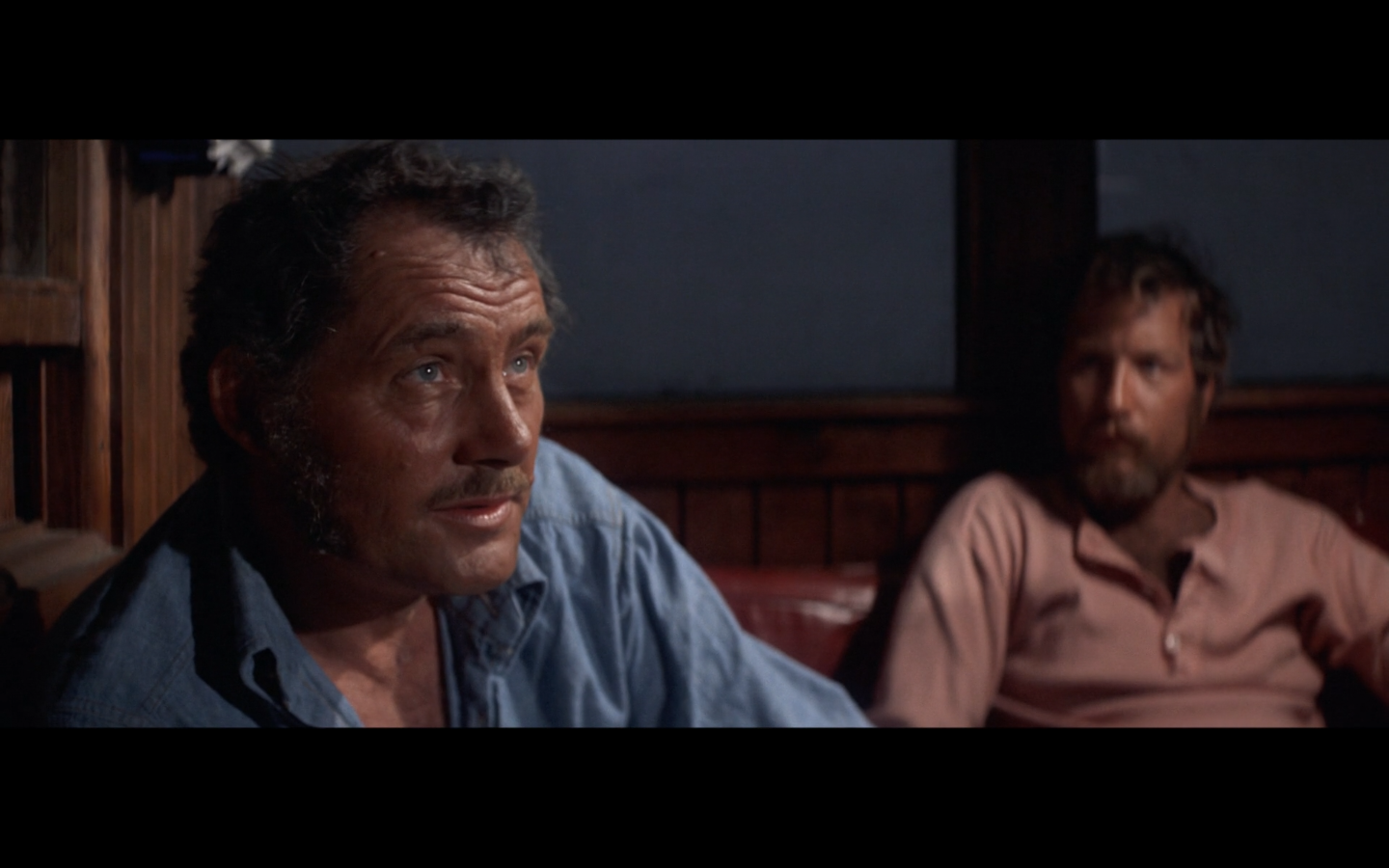
Pic of the Day: “Japanese submarine slammed two torpedoes into our side, Chief. We was comin’ back from the island of Tinian to Leyte… just delivered the bomb. The Hiroshima bomb. Eleven hundred men went into the water. Vessel went down in 12 minutes. Didn’t see the first shark for about a half an hour. Tiger. 13-footer….”
“…You know how you know that when you’re in the water, Chief? You tell by looking from the dorsal to the tail fin. What we didn’t know, was our bomb mission had been so secret, no distress signal had been sent. They didn’t even list us overdue for a week. Very first light, Chief, sharks come cruisin’, so we formed ourselves into tight groups. You know, it was kinda like old squares in the battle like you see in the calendar named “The Battle of Waterloo” and the idea was: shark comes to the nearest man, that man he starts poundin’ and hollerin’ and screamin’ and sometimes the shark will go away… but sometimes he wouldn’t go away. Sometimes that shark he looks right into ya. Right into your eyes. And, you know, the thing about a shark… he’s got lifeless eyes. Black eyes. Like a doll’s eyes. When he comes at ya, doesn’t seem to be living… until he bites ya, and those black eyes roll over white and then… ah then you hear that terrible high-pitched screamin’. The ocean turns red, and despite all the poundin’ and the hollerin’, they all come in and they… rip you to pieces. You know by the end of that first dawn, lost a hundred men. I don’t know how many sharks, maybe a thousand. I know how many men, they averaged six an hour. On Thursday morning, Chief, I bumped into a friend of mine, Herbie Robinson from Cleveland. Baseball player. Boatswain’s mate. I thought he was asleep. I reached over to wake him up. He bobbed up, down in the water just like a kinda top. Upended. Well, he’d been bitten in half below the waist. Noon, the fifth day, Mr. Hooper, a Lockheed Ventura saw us. He swung in low and he saw us… he was a young pilot, a lot younger than Mr. Hooper. Anyway, he saw us and he come in low and three hours later a big fat PBY comes down and starts to pick us up. You know that was the time I was most frightened… waitin’ for my turn. I’ll never put on a lifejacket again. So, eleven hundred men went in the water; 316 men come out and the sharks took the rest, June the 29th, 1945. Anyway, we delivered the bomb.”
The Oscar Quest: Best Actor – 1985
I hate 1985. Nearly every decision was wrong. It starts at the top. Out of Africa wins Best Picture and Best Director for Sydney Pollack. Let’s start with Best Picture. It was a terrible decision. The film just — isn’t that good. I mean, it’s a fine film and all, but — The Color Purple was also nominated this year. That, by all accounts, is clearly the better film. The fact that it didn’t win speaks to the oldest tradition in Academy history — racism. That’s the only explanation. Steven Spielberg, who directed The Color Purple and won the DGA Award for it, wasn’t even nominated for Best Director! (Which makes the Sydney Pollack decision okay, since he did a good job with his film and was a good director. Though the Academy did have the chance to award Akira Kurosawa here. But, I do understand the choice, if Spielberg wasn’t nominated.)
Then, Best Actress was another racist decision. Whoopi Goldberg was clearly the best performance in the category, and yet the Academy gives Best Actress to Geraldine Page for The Trip to Bountiful (talked about here). Oh, this racism is killing me inside. Geraldine Page was a respected actress with 8 nominations to her name. But don’t let that fool you. They used her veteran status as an excuse to be racist. Watch the performances — you’ll see what I mean. Then Best Supporting Actor was Don Ameche for Cocoon, which was a veteran win, no more, no less. This one I can kind of get behind. I mean, Klaus Maria Brandauer was strong in Out of Africa, but I don’t like that film, and Eric Roberts was awesome in Runaway Train, but I don’t think the Academy would have voted for him. So I guess this result is kind of okay. Then Best Supporting Actress was Anjelica Huston for Prizzi’s Honor (talked about here), which, I don’t really like all that much. At all, in fact.
So that’s 1985. Of the 6 decisions, I like one of them. This one. Then three of them are terrible, I don’t like one (Supporting Actress) but can live with it a little bit (though my dislike still stands) and can live with the other one (Supporting Actor). All in all a terrible year.
BEST ACTOR – 1985
And the nominees were…
Harrison Ford, Witness
James Garner, Murphy’s Romance
William Hurt, Kiss of the Spider Woman
Jack Nicholson, Prizzi’s Honor
Jon Voight, Runaway Train (more…)
The Oscar Quest: Best Director – 1957
1957 is one of those great years for the Academy. A great film wins Best Picture and is so unquestionably obvious a choice that no one can really speak ill of it (even though another nominated film, in this case, 12 Angry Men, is just as good and is also a classic). The Bridge on the River Kwai wins Best Picture, along with this category and Best Actor for Alec Guinness. Great decisions, the lot.
Best Actress this year was Joanne Woodward for The Three Faces of Eve (talked about here), which is a fantastic decision that I not only love, but see as one people can’t disagree with, given the category. I love that. There’s nothing more annoying than a great decision that people don’t like because of whatever stupid reason they have. Best Supporting Actor and Best Supporting Actress this year were Red Buttons and Miyoshi Umeki for Sayonara, which I count as two of the worst decisions of all time in their respective categories (Best Supporting Actor because of the competition (and weakness of the performance), Best Supporting Actress because of the weakness of the performance).
So that’s 1957. Love the year outside of the Supporting categories. Which basically means I love the year. Because who gives a shit about the Supporting categories? Am I right? Right? High five!
(Awkward pause as we realize there is no joke going into the break…)
BEST DIRECTOR – 1957
And the nominees are…
David Lean, Bridge on the River Kwai
Joshua Logan, Sayonara
Sidney Lumet, 12 Angry Men
Mark Robson, Peyton Place
Billy Wilder, Witness for the Prosecution (more…)
 B+ Movie Blog